
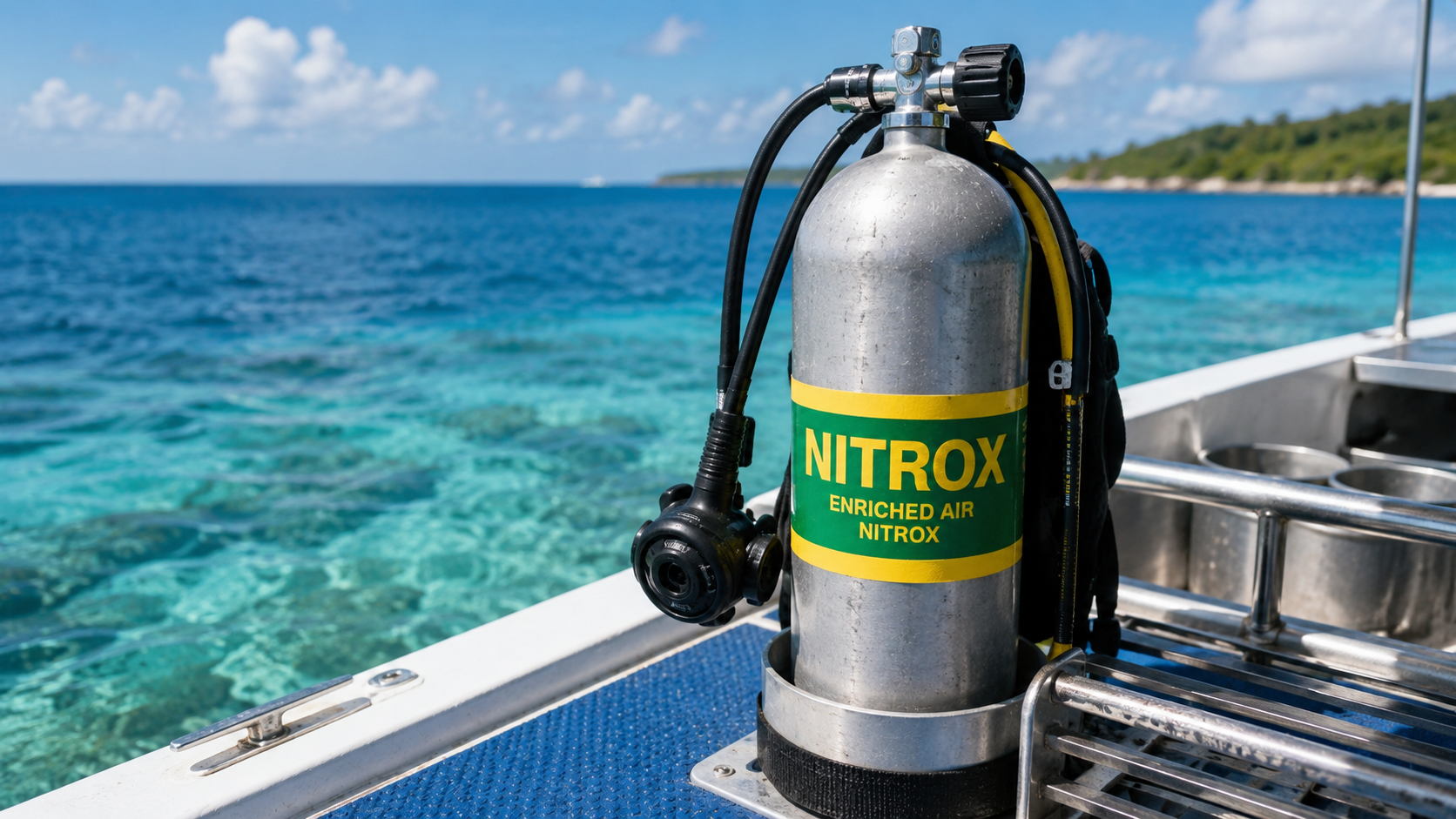
Nitrox Made Simple for Recreational Divers
Nitrox sounds more intimidating before you take the class.
At least it did to me.
Before I understood it, Nitrox felt like one of those scuba topics that belonged to more advanced divers. It came with numbers, oxygen percentages, partial pressure, MOD calculations, computer settings, and enough technical language to make it feel more complicated than it really is.
Then I took the course and realized the practical idea is not that mysterious.
At the recreational level, Nitrox is not magic. It does not turn you into a technical diver. It does not make you immune to dive limits. It does not let you ignore your computer, your depth, your gas, or your training.
It is a planning tool.
A very useful one.
For me, Enriched Air Nitrox became one of the first specialties that changed how I thought about repetitive dive days, warm-water trips, and two-tank boat diving. It helped me stop thinking of a dive as one isolated event and start thinking more about the whole day, the next day, and what my computer is tracking across the week.
SSI includes Enriched Air Nitrox among its specialty programs, alongside courses like Deep Diving, Equipment Techniques, Perfect Buoyancy, Navigation, Night & Limited Visibility, Wreck Diving, and others. In my own progression, Nitrox came early. My dive file shows I completed Enriched Air Nitrox Level 2, 40%, on Feb. 11, 2025, after Open Water and before Deep Diving, Equipment Techniques, Perfect Buoyancy, and React Right.
Looking back, that timing made sense.
Nitrox was one of the first courses that made me feel like I was not just going diving.
I was planning dives.
What Nitrox Actually Means
Regular air is roughly 21% oxygen and 79% nitrogen.
Nitrox, also called Enriched Air Nitrox or EANx, is breathing gas with more oxygen than regular air. Common recreational mixes include EAN32 and EAN36, which means 32% oxygen or 36% oxygen.
The basic idea is simple: if the gas has more oxygen, it has less nitrogen.
That matters because nitrogen loading is one of the big things your dive computer is tracking. When there is less nitrogen in the breathing gas, a diver may get more no-decompression time on certain dive profiles.
That is the practical reason recreational divers use Nitrox.
Not because it gives you more gas.
Not because it lets you go deeper.
Not because it makes the dive risk-free.
It can reduce nitrogen exposure compared to air, which may be useful when your dive profile is limited by no-decompression time instead of how much gas is left in the tank.
That last part matters because Nitrox does not solve every problem. It solves a specific planning problem.
Used correctly, that can be a big deal.
The Biggest Misunderstanding: Nitrox Does Not Let You Go Deeper
This is probably the first thing a new Nitrox diver needs to understand.
Nitrox does not increase your maximum depth.
In many cases, it reduces it.
That sounds backwards at first. If Nitrox is “better air,” people naturally assume it must let you do more of everything. More time. More depth. More safety. More options.
That is not how it works.
The extra oxygen is useful, but it also has limits. As you go deeper, pressure increases. As pressure increases, the partial pressure of oxygen increases too. If you take a high-oxygen mix too deep, oxygen toxicity becomes a concern.
That is why every Nitrox mix has a maximum operating depth, usually called MOD.
The higher the oxygen percentage, the shallower the MOD.
This is one of the reasons Nitrox made me take planning more seriously. You cannot just grab a tank, assume it is fine, and go diving. You need to know what is in the cylinder. You need to analyze it. You need to set your computer correctly. You need to understand the depth limit for that mix.
Nitrox is not a “better air” button.
It is a gas choice with responsibilities attached.
What Nitrox Is Best At
Nitrox shines when no-decompression time matters.
That is not every dive. On a shallow, easy dive where gas supply is the limiting factor, Nitrox may not make a major difference. But on repetitive dive days, especially warm-water boat diving, it can become much more useful.
That is where I started to see the value.
A lot of recreational dive travel follows a familiar rhythm: two morning dives, surface interval, lunch, rest of the day, then another dive morning after that. Do that for several days in a row, and your computer is not only thinking about one dive. It is tracking the whole pattern.
That is where Nitrox starts to feel practical.
It can be useful for:
| Dive Situation | Why Nitrox May Help |
|---|---|
| Repetitive dive days | Helps manage nitrogen loading across multiple dives |
| Multi-day dive trips | Supports planning over several dive mornings |
| Two-tank boat dives | Often useful when the first dive is deeper |
| Moderate-depth reef dives | May extend no-decompression limits |
| Warm-water travel diving | Fits common resort and boat-dive profiles |
| Dives where gas is not the first limit | Lets no-decompression planning matter more |
It still does not give unlimited bottom time. The dive is still limited by gas supply, depth, conditions, current, buddy team, operator rules, and personal comfort.
But when the profile fits, Nitrox can make the day feel less tight from a computer-planning standpoint.
That is the part I appreciate.
What Nitrox Does Not Do
Nitrox gets oversold sometimes, especially to newer divers who hear that it gives “more bottom time” and stop listening after that.
So it is worth being clear.
Nitrox does not let you dive deeper. It does not replace dive planning. It does not eliminate decompression risk. It does not fix bad buoyancy. It does not improve air consumption. It does not remove the need for a surface interval. It does not make an unsafe dive safe.
That last one is the big one.
If the current is stronger than you are comfortable with, Nitrox does not fix that. If the site is beyond your training, Nitrox does not fix that. If your buoyancy is sloppy, Nitrox does not fix that. If you are task-loaded, cold, anxious, tired, or diving with a poor plan, Nitrox does not magically make the dive smart.
It is a good tool.
But it is still just a tool.
That is how I try to think about it now. Useful, practical, and worth having, but not something that replaces judgment.
Why EAN32 Is So Common
A lot of recreational dive operations use EAN32 as a common Nitrox mix.
That makes sense.
EAN32 is a practical middle ground for many recreational profiles. It has less nitrogen than air, but it still allows a useful depth range when planned correctly. For a lot of reef dives, wall dives, and two-tank boat profiles, it is a mix that operators and divers can work with consistently.
That consistency matters.
If a boat is set up around common recreational profiles and most Nitrox divers are using the same mix, the planning can be cleaner. The briefings can be clearer. The process becomes more predictable.
But the diver still has a job.
Even if everyone says the tanks are Nitrox 32, I still need to analyze my own tank. I still need to confirm what is actually in it. I still need to set my computer for the gas I am breathing.
Assumptions are not a good dive plan.
The tank in front of me is my responsibility.
The Tank Analysis Habit Matters
One of the most useful parts of Nitrox training is not the math.
It is the habit.
Analyze the tank. Confirm the oxygen percentage. Confirm the MOD. Mark or verify the tank. Set the computer. Dive the plan.
That routine matters because it forces ownership.
If I think I am diving air but I am actually diving Nitrox, my computer settings may be wrong. If I think I am diving Nitrox 32 but the tank is actually a different mix, my MOD and no-decompression information may be wrong. If my computer does not match the gas in the cylinder, the information I am relying on during the dive may not mean what I think it means.
That is not a small issue.
Nitrox made me more aware that diving is not passive. I am not just handed gear and dropped in the water. I am part of the safety system.
I like that about the course.
It builds a habit that carries into other parts of diving.
Check the gear. Verify the plan. Do not assume.
Nitrox and Dive Computers
Nitrox also changed the way I think about my dive computer.
Before Nitrox, it is easy to treat the computer like a smart depth watch. It tells you where you are, how long you have been there, and when to slow down or stop.
Once you start diving Nitrox, the computer becomes more obviously tied to the plan.
It needs to know what gas you are breathing. If I am diving air, the computer needs to be set for air. If I am diving Nitrox 32, it needs to be set for Nitrox 32. If the mix is different, the setting needs to match the actual analyzed gas.
That setting is not cosmetic.
It affects no-decompression calculations, oxygen exposure tracking, and the information the computer gives me during the dive.
That is one reason I think Nitrox is a good early specialty. It pushes you to understand your computer better. You stop treating it like a magic wrist clock and start treating it like an instrument that depends on correct input.
Depth matters.
Time matters.
Gas mix matters.
Surface interval matters.
Repetitive exposure matters.
Nitrox makes all of that more visible.
Nitrox Does Not Fix Bad Air Consumption
This is another misunderstanding I think newer divers can have.
Nitrox does not make the tank last longer.
An aluminum 80 is still an aluminum 80. Your breathing rate is still your breathing rate. If you are working hard, stressed, swimming inefficiently, fighting buoyancy, or dealing with current, you are still going to use gas faster.
Nitrox can help with no-decompression limits on certain profiles. It does not increase the physical amount of breathing gas in the cylinder.
That distinction matters.
If I am ending dives because I am low on gas, Nitrox may not be the thing that changes that. The bigger fixes are usually more boring and more skill-based: slow down, improve buoyancy, improve trim, reduce unnecessary hand movement, relax my breathing, streamline gear, stay within comfort limits, and keep building experience.
Nitrox supports the plan.
It does not breathe for me.
That is a useful reality check.
Where Nitrox Fits in a Real Dive Trip
For one shallow dive, Nitrox may not matter much.
For a week of repetitive morning dives, it can matter a lot more.
That is how I think about it now.
If I am planning a dive trip, especially one built around several two-tank mornings, I want to know whether Nitrox is available, what mix the operator commonly uses, whether it costs extra, and what depths are expected.
I also want to know whether everyone in the dive group is certified for it and whether everyone understands what they are actually diving.
That matters when diving with family or a group.
If one diver is on air and another is on Nitrox, their computers may give different no-decompression limits. If one diver is newer, has higher gas consumption, or is less comfortable with the profile, the dive should still be planned around the team, not just the diver with the most generous computer.
Good dive planning is not about maximizing one person’s numbers.
It is about keeping the team inside a smart plan.
That is the kind of thinking Nitrox encourages.
Why I Am Glad I Took Nitrox Early
I am glad I took Nitrox early because it made future diving easier to understand.
It gave me a better framework for gas, depth, repetitive dives, computer settings, and no-decompression planning. It also paired naturally with later courses.
Deep Diving made depth feel more serious. Equipment Techniques connected the gear to the system. Perfect Buoyancy showed how much control affects the whole dive. React Right added another layer of emergency readiness. My own certification path shows that progression clearly: Open Water, Enriched Air Nitrox, Deep Diving, Equipment Techniques, Perfect Buoyancy, and React Right.
Nitrox did not make me an advanced diver by itself.
But it did make me a more thoughtful diver earlier.
That is the value.
It helped me ask better questions before the dive, not just react to numbers during the dive.
A Simple Way to Think About Nitrox
The simplest way I can explain it is this:
Air is the default.
Nitrox is a planning choice.
Use it when it supports the dive profile. Respect its depth limits. Analyze the tank. Set the computer. Do not treat it like a free pass. Do not assume it makes every dive better. Do not let the gas choice outrun training, conditions, or comfort.
Used well, Nitrox is one of the most practical recreational scuba specialties out there.
Used casually, it can create false confidence.
The difference is planning.
That is what the course really gave me.
Final Thought
Nitrox made scuba feel less mysterious to me.
Not because it simplified everything, but because it forced me to understand more of what was already happening. Gas mix, nitrogen loading, oxygen exposure, maximum operating depth, dive computer settings, and repetitive dive planning were always part of the picture. Nitrox just made me pay closer attention.
That is what good scuba training should do.
It should not just add another card to the profile.
It should make you a better planner, a calmer diver, and someone who understands more of the system keeping you safe underwater.
That is why Nitrox matters to me.
Not because it is complicated.
Because once you understand it, it is practical.