What’s in My Dive Bag
Scuba gear can get out of hand fast.
At first, it feels simple. You need a mask, fins, maybe boots, and whatever rental gear the shop puts in front of you. Then you start diving more. You start taking classes. You start traveling. You start paying attention to what feels comfortable, what feels awkward, what makes the dive easier, and what creates problems you do not want to deal with on a boat.
Eventually, the question changes.
It stops being, “What gear can I buy?”
It becomes, “What gear actually supports the diving I do?”
That is the question behind my dive bag.
I am not trying to build a technical cave-diving setup. I am not trying to own every gadget someone mentions online. I am not trying to look like the most experienced diver on the boat. I want a kit that is reliable, familiar, serviceable, comfortable, and suited to the kind of diving I actually do.
For me, that means recreational warm-water diving, travel diving, Nitrox, deeper recreational profiles, reef dives, drift dives, occasional wreck-adjacent dives, underwater video, and family dive trips where the schedule still has to work after the boat comes back.
SSI includes Equipment Techniques as one of its specialty programs, along with Deep Diving, Enriched Air Nitrox, Perfect Buoyancy, Navigation, React Right, Wreck Diving, and other progression options. That course makes sense to me because gear is not just stuff. It is the system you are trusting underwater.
This is the kit I am learning through.
My Gear Philosophy
I think about dive gear in layers.
Some gear keeps you alive. Some gear keeps you comfortable. Some gear helps you stay safer if conditions change. Some gear just keeps the boat day organized.
Those are not the same thing.
A new accessory does not matter much if I do not understand my regulator, if my mask leaks, if I cannot read my computer quickly, or if my SMB is clipped somewhere I cannot actually reach it when I need it.
So my gear philosophy is pretty simple: the gear should make the dive calmer.
If something adds confusion, clutter, or task loading, it needs to earn its place.
Here is the basic way I sort it:
| Layer | Purpose |
|---|---|
| Life-support gear | Regulator, alternate air, BCD, gauges, computer |
| Fit and comfort gear | Mask, fins, boots, wetsuit, thermal layer |
| Safety and signaling gear | SMB, reel, rescue GPS, visual or audible signaling |
| Travel and organization gear | Mesh bag, small accessories, clips, storage habits |
That hierarchy helps me avoid chasing shiny things just because they look useful.
Good gear should solve a real problem.
Regulator Setup: The Breathing System
My regulator setup is built around a Mares 62X First Stage, a Mares Dual ADJ 62X second stage, and a Mares Dual Adj Octo alternate air source. Those are listed in my gear file as my primary first stage, primary second stage, and alternate air setup.
This is the part of the kit where I want boring in the best possible way.
I want the regulator to breathe consistently. I want the hose routing to make sense. I want the alternate air source to be where I expect it to be. I want to know how the whole setup feels before I am on a boat somewhere with current, a camera, a buddy, and a dive plan to think about.
A regulator is not where I want surprises.
I also do not want to be learning the personality of my breathing system on every trip. The more dives I put on the same setup, the more familiar it becomes. That familiarity matters. It lowers the mental noise before the dive even starts.
That is the goal with life-support gear.
Not excitement.
Trust.
BCD: Stability, Trim, and Familiarity
My BCD is the Mares Bolt SLS BCD, which is listed in my gear inventory as my buoyancy control device.
When you are new, it is easy to think of the BCD as the jacket that holds the tank and lets you go up or down. Technically, yes. But once you start diving more, you realize it affects a lot more than that.
A BCD affects trim. It affects comfort. It affects pocket access. It affects hose routing. It affects how the tank sits on your back. It affects how stable you feel at the surface and how clean you feel underwater.
I want my BCD to feel familiar enough that I am not thinking about it constantly.
I want to know where the inflator is. I want to know where the dump valves are. I want to know how it feels when I add a little air, dump a little air, or hold a safety stop. I want it to support the dive instead of becoming another thing to manage.
A good BCD does not make buoyancy automatic.
But a familiar BCD makes buoyancy easier to practice.
Computer and Gauges: The Information Layer
My computer is a Mares Puck Pro EZ Wrist Computer, and I also use a SeaElite Slimline 3 Gauge Console for pressure and related information. Both are listed in my gear inventory.
This is the part of the gear system that keeps me honest.
Depth, time, no-decompression limit, ascent information, safety stop, dive history, Nitrox settings, and gas pressure all matter. The computer does not make decisions for me, but it gives me information I need to make better decisions.
I like having a wrist computer because it is easy to check often without hunting for a console. That matters on deeper dives, drift dives, and any dive where I want the numbers visible without making a production out of it.
I also like having pressure information on a physical console because gas checks need to be simple and obvious. I do not want to be casual about air. I want that habit to be boring and consistent.
The important part is not just owning a computer.
It is knowing how it behaves.
How do I set Nitrox? How does it show no-decompression time? What does it do on a safety stop? How does it behave after repetitive dives? What screen do I need during the dive, and what can wait until later?
A simple computer you understand is better than a fancy one you are guessing at.
Mask: Clarity Comes First
My mask is the Tusa Freedom HD Mask, listed in my gear file as my primary mask.
A mask feels like basic gear until it is wrong.
A leaking mask can turn a good dive into a constant annoyance. A poor fit can make mask clearing more stressful than it needs to be. A narrow field of view can make the whole dive feel more closed in.
For me, a mask needs to do three things well: seal reliably, stay comfortable, and give me a clear view of the dive.
That last part matters a lot to me because I care about underwater clarity. I want to see the reef clearly. I want to see my buddy clearly. I want to see what I am filming clearly. If the mask is fighting me, everything else gets harder.
This is one of the first pieces of personal gear I think new divers should take seriously.
Rental gear can be perfectly workable in a lot of categories, but a mask that fits your face is personal. When it works, you barely think about it. When it does not, it can dominate the dive.
Fins and Boots: Movement Without Fighting the Water
My fins are Scubapro Seawing Nova Fins, and my boots are Seac Pro HD 6mm Boots. Both are listed in my gear file.
Fins are one of those pieces of gear people can underestimate early on.
The wrong fins can make every kick feel like work. The wrong boots can rub, shift, or make the fin fit feel off. And if your propulsion feels inefficient, that affects more than speed. It affects breathing, gas use, trim, and overall comfort.
For the diving I do, I want fins that can handle boat dives, current, and long reef profiles without making me feel like I am fighting the water.
The goal is not to be fast.
The goal is to move efficiently.
Good fins help me stay controlled, avoid stirring up the bottom, avoid kicking coral, and avoid burning energy I do not need to burn. That connects directly to buoyancy. If I am constantly working too hard with my fins, the whole dive gets less relaxed.
Good movement underwater should feel deliberate, not frantic.
Exposure Protection: Warm Enough Without Overbuilding
My exposure setup includes a Henderson Thermaxx 3mm wetsuit and a Henderson Hotskins Classic Unisex Spandex Jumpsuit as a thermal layer. Both are part of my listed gear.
Exposure protection is personal. Some divers get cold quickly. Some do not. Some warm-water destinations are warmer on paper than they feel after a long second tank. A breezy boat ride after the dive can also change how comfortable the whole morning feels.
For warm-water travel, a 3mm wetsuit is a practical baseline for me. It gives enough protection from cooler water, sun, scrapes, and repeated exposure without feeling like too much for tropical diving.
The thermal layer gives me another option without completely changing the system. I may not need it every dive, but I like having flexibility.
The key is matching exposure protection to the actual diving, not just the destination name.
“Warm water” is not always the whole story.
Cylinder: The Standard Workhorse
My gear inventory includes an Aluminum 80 scuba tank.
For travel, I am usually not flying with tanks. Most destination operators provide cylinders, and that is normal. But training with and understanding a standard AL80 still matters because it is such a common recreational setup.
A tank is not just a container of gas.
It is part of the buoyancy system.
An aluminum tank changes as the dive goes on. It gets lighter as gas is used, and that affects weighting and end-of-dive buoyancy. That is one of those details that becomes more real the more you dive.
It also reminds me that weighting is not just about getting down at the start.
It is about controlling the whole dive, including the end, when the tank is lighter and the safety stop still needs to be calm.
SMB and Reel: Not Optional in My Mind
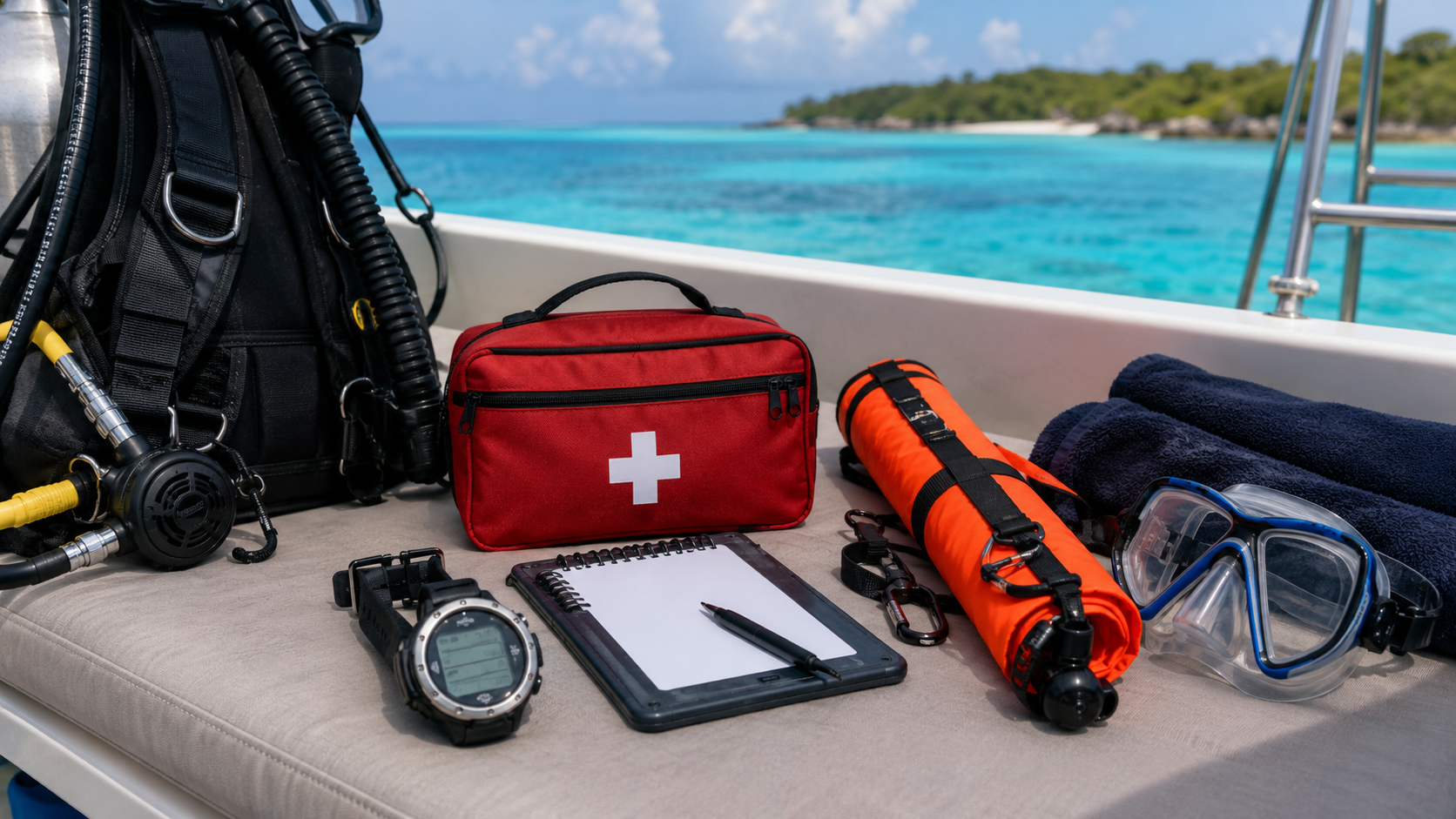
My safety kit includes a HOG 72-inch SMB with reel combo, which is listed in my gear file.
An SMB is one of those items I think every diver should take seriously, especially for boat dives, drift dives, and destinations with current.
It is not decoration. It is not something to clip on just because other divers have one.
It is a signaling tool.
It helps boats see you. It can support a controlled ascent in certain situations. It gives a buddy team another way to be visible if they surface away from the boat.
But owning an SMB is not the same as being comfortable with it.
I need to know where it is clipped. I need to know how the reel works. I need to avoid creating an entanglement problem. I need to be able to manage buoyancy while deploying it. I need to practice enough that it does not feel like a brand-new skill during a stressful moment.
That is the part that matters most.
I do not want my first meaningful SMB deployment to happen when I actually need it.
Rescue GPS: The “Hope I Never Need It” Tool
My kit also includes a Nautilus Lifeline Marine Rescue GPS, listed under signaling accessories.
This is one of those pieces of gear I carry because boat diving and drift diving have real variables.
Current moves. Boats move. Visibility changes. Surface conditions change. People can surface farther from the boat than planned.
I do not carry a rescue GPS because I expect something to go wrong. I carry it because low-probability, high-consequence problems are still worth thinking about.
That is part of being serious about diving.
The goal is to never need it.
But “I hope I never need it” is not the same as “I should not carry it.”
Mesh Boat Bag: Organization Matters
My dive bag is an Edge Deluxe Mesh Boat Duffel Bag, which is listed in my gear inventory.
A mesh bag is not exciting, but it makes boat days easier.
Wet gear needs to drain. Small gear needs to stay together. The kit needs to move from room to vehicle to dock to boat and back again without turning into a scavenger hunt.
That matters more than people think.
A messy bag creates stress. It makes it easier to lose things, forget things, or spend the start of the dive day digging around instead of getting ready.
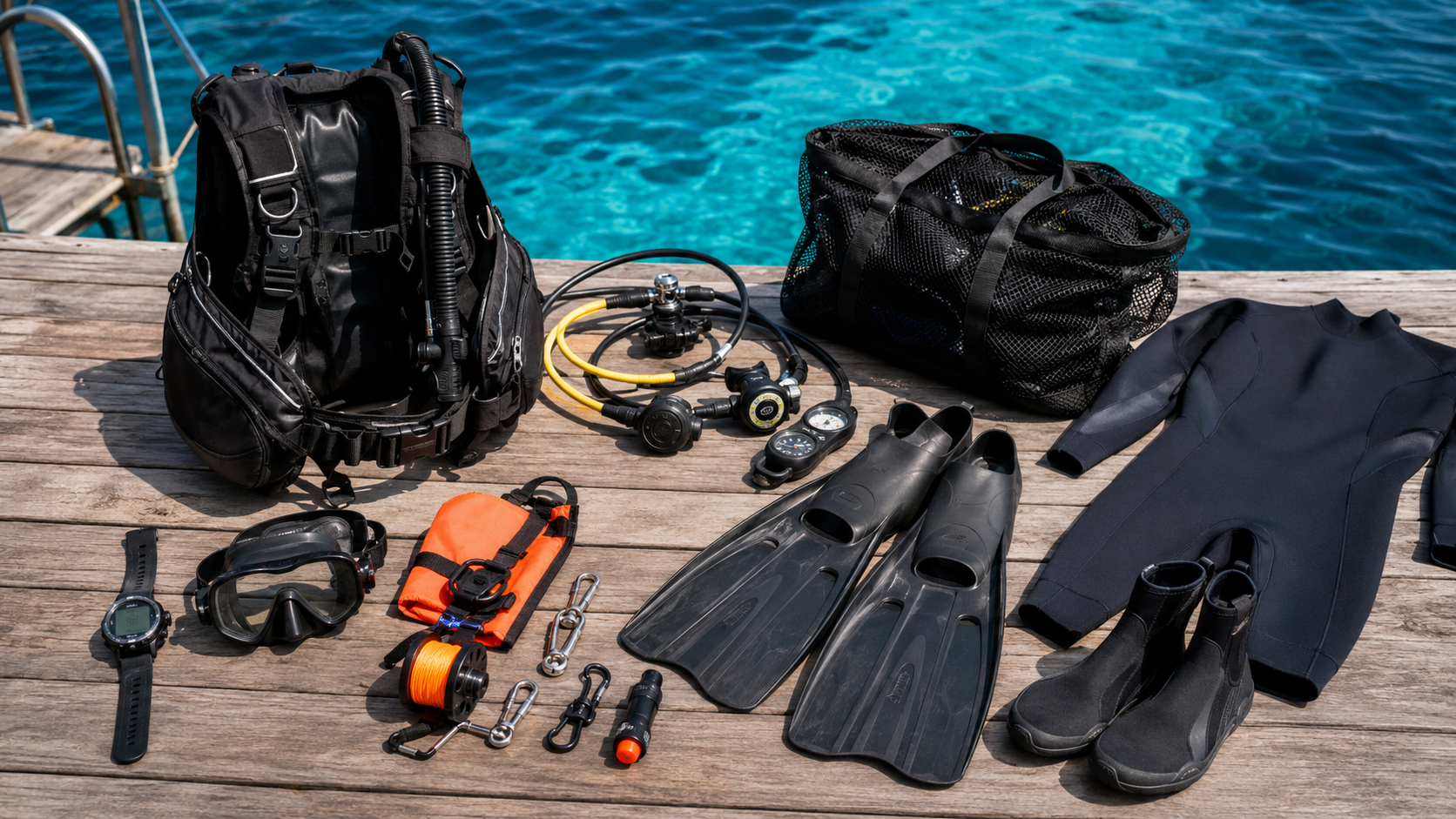
I want to know where my mask is. I want to know where my computer is. I want to know where the SMB is. I want my fins, boots, wetsuit, regulator, and accessories to have a predictable place.
Organization is not glamorous.
It is just one more way to lower the friction of the dive day.
The Gear I Think About Most
Not every piece of gear gets the same amount of attention before a trip.
Some items matter because they are life support. Some matter because they can ruin comfort if they are wrong. Some matter because they become important when conditions change.
Here is the gear that usually gets the most attention from me:
| Gear Item | Why It Gets Attention |
|---|---|
| Regulator | Life support, service status, breathing reliability |
| BCD | Fit, trim, buoyancy, comfort |
| Computer | Nitrox settings, battery, familiarity |
| Mask | Fit, seal, clarity |
| Fins and boots | Comfort, propulsion, current handling |
| SMB and reel | Surface signaling, drift readiness |
| Rescue GPS | Emergency signaling backup |
| Wetsuit | Temperature, comfort, sun and scrape protection |
| Mesh bag | Boat organization and transport |
That list keeps me honest.
The shiny gear is not always the important gear. I would rather have a reliable, familiar, slightly boring setup than a complicated setup I barely understand.
Boring is underrated in scuba.
What I Would Tell a New Diver Buying Gear
I would not tell every new diver to buy everything at once.
Some divers know right away that they are going to dive often. Others are still figuring out how much they love it, where they will dive, and what kind of diving they will actually do. Buying a full kit before you know your own preferences can get expensive fast.
I would start with fit-critical personal gear.
Mask. Fins. Boots. Exposure protection if needed.
Those pieces affect comfort immediately, and they are personal enough that owning your own makes sense early.
After that, I would start thinking about the bigger system: computer, SMB and reel, regulator, BCD, signaling equipment, and bag organization.
The key is being honest about how you dive.
Warm water or cold water? Local diving or travel diving? Boat diving or shore diving? Drift diving? Photography? Deep recreational? Once-a-year vacation dives? Multi-day dive trips?
The best gear for someone else may not be the best gear for you.
Gear should match the diving you actually do, not the diver you imagine becoming someday.
Equipment Techniques Made More Sense After I Owned Gear
Taking Equipment Techniques made more sense once I had more of my own gear.
Before that, equipment knowledge can feel abstract. Once you have a regulator, BCD, computer, gauges, exposure gear, safety accessories, and a travel setup, the class connects to real decisions.
How do I inspect my gear? What can I recognize on my own? What needs professional service? How should everything be routed? What feels normal, and what feels off? What do I need to check before I am standing on a boat with a dive guide waiting?
That is the value.
A good diver does not have to be a service technician. I am not trying to become one. But I do want to understand my own kit well enough to inspect it, assemble it properly, recognize obvious problems, and know when something needs attention.
Being familiar with your own gear is part of being responsible for your own dive.
My Current Dive Bag Is Still Evolving
I do not think a dive bag is ever truly finished.
As the diving changes, the gear changes.
More night dives would put more focus on lights. More wreck-focused dives would change accessory priorities. More local diving might change exposure protection. More video might change camera mounts, lighting, filters, batteries, and storage. More advanced training could change redundancy expectations.
That is normal.
The danger is letting the kit evolve randomly.
Every new piece of gear should answer a question:
What problem does this solve?
If I cannot answer that, I probably do not need it yet.
That question keeps the bag from turning into a junk drawer with fins.
Final Thought
My dive bag is not built around showing off.
It is built around familiarity, safety, comfort, and the kind of diving I actually do.
Regulator. BCD. Computer. Mask. Fins. Boots. Wetsuit. SMB. Reel. Rescue GPS. Mesh bag.
Each piece has a job.
Some jobs are obvious. Some are quiet. Some only matter when conditions change or when the plan does not go exactly the way it was supposed to.
That is why gear matters.
Not because gear makes you a better diver by itself. It does not.
But good gear, understood well, maintained properly, and used consistently, supports better diving.
That is the goal.
Not more stuff.
Better systems.