Perfect Buoyancy Is Not Optional
Perfect buoyancy sounds like one of those polished scuba skills you work on after the basics are handled.
I do not think that way anymore.
The more I dive, the more I see buoyancy as one of the main things holding everything else together. It affects how much energy I use, how much gas I burn, how close I get to the reef, how stable my camera footage is, how comfortable I feel on deeper profiles, and how calm the whole dive feels from start to finish.
It is easy to think of buoyancy as a style thing. You see an experienced diver hovering perfectly still, barely moving, and it looks graceful. It looks smooth. It looks like something nice to have.
But that is not the real point.
Good buoyancy is not about looking good underwater.
It is about being in control.
SSI includes Perfect Buoyancy among its specialty programs, along with Deep Diving, Enriched Air Nitrox, Equipment Techniques, Navigation, Night & Limited Visibility, Wreck Diving, React Right, and others. In my own progression, Perfect Buoyancy came after Open Water, Enriched Air Nitrox, Deep Diving, and Equipment Techniques. My dive file shows I completed Perfect Buoyancy on Jan. 19, 2026.
That timing made sense. By then, I had enough dives to understand that buoyancy was not just another course. It was the skill underneath almost every other skill.
Buoyancy Is the Difference Between Diving and Fighting the Water
A new diver can be certified and still spend a lot of time fighting the water.
I know that sounds harsh, but it is true.
You can be safe, capable, and certified, but still feel like the dive is busier than it should be. You add air, then dump air. You sink a little, then kick up. You float a little, then pull yourself back down. You use your hands without realizing it. You feel like you are constantly reacting instead of settling into the dive.
That gets tiring fast.
It also makes the dive feel smaller. Instead of noticing the reef, the marine life, the wall, the current, or your buddy, you are stuck managing yourself every few seconds.
Good buoyancy changes that.
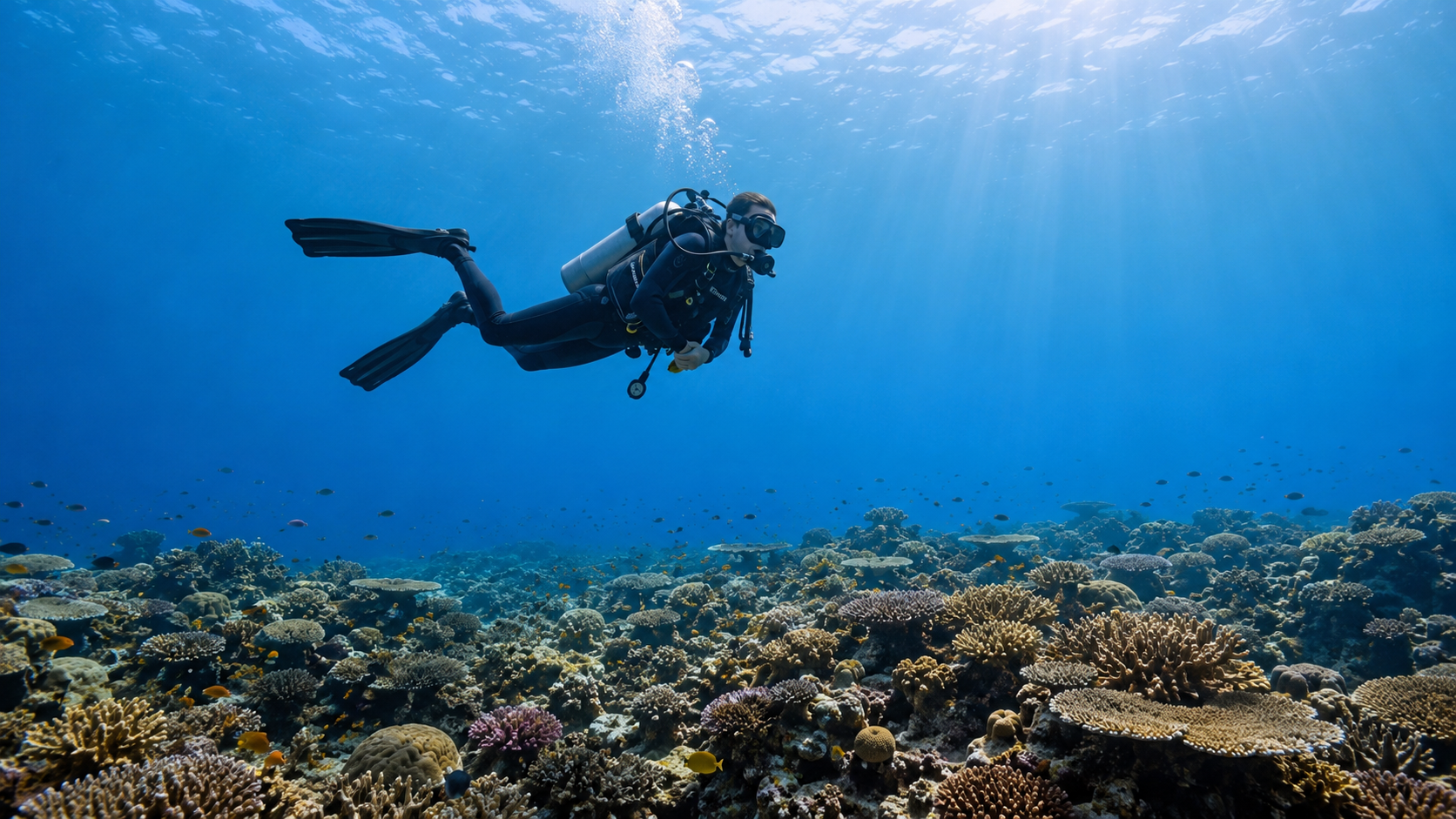
When buoyancy starts working, the dive gets quieter. You stop fighting every little movement. You hover longer. Your breathing settles down. You can look around without immediately rising or dropping. You start to feel like you are part of the water instead of someone constantly correcting against it.
That is when scuba starts to feel different.
Not easier because it takes no skill, but calmer because the skill is finally doing its job.
The Reef Does Not Care That You Are New
This is one of the uncomfortable truths of diving.
The reef does not know your experience level.
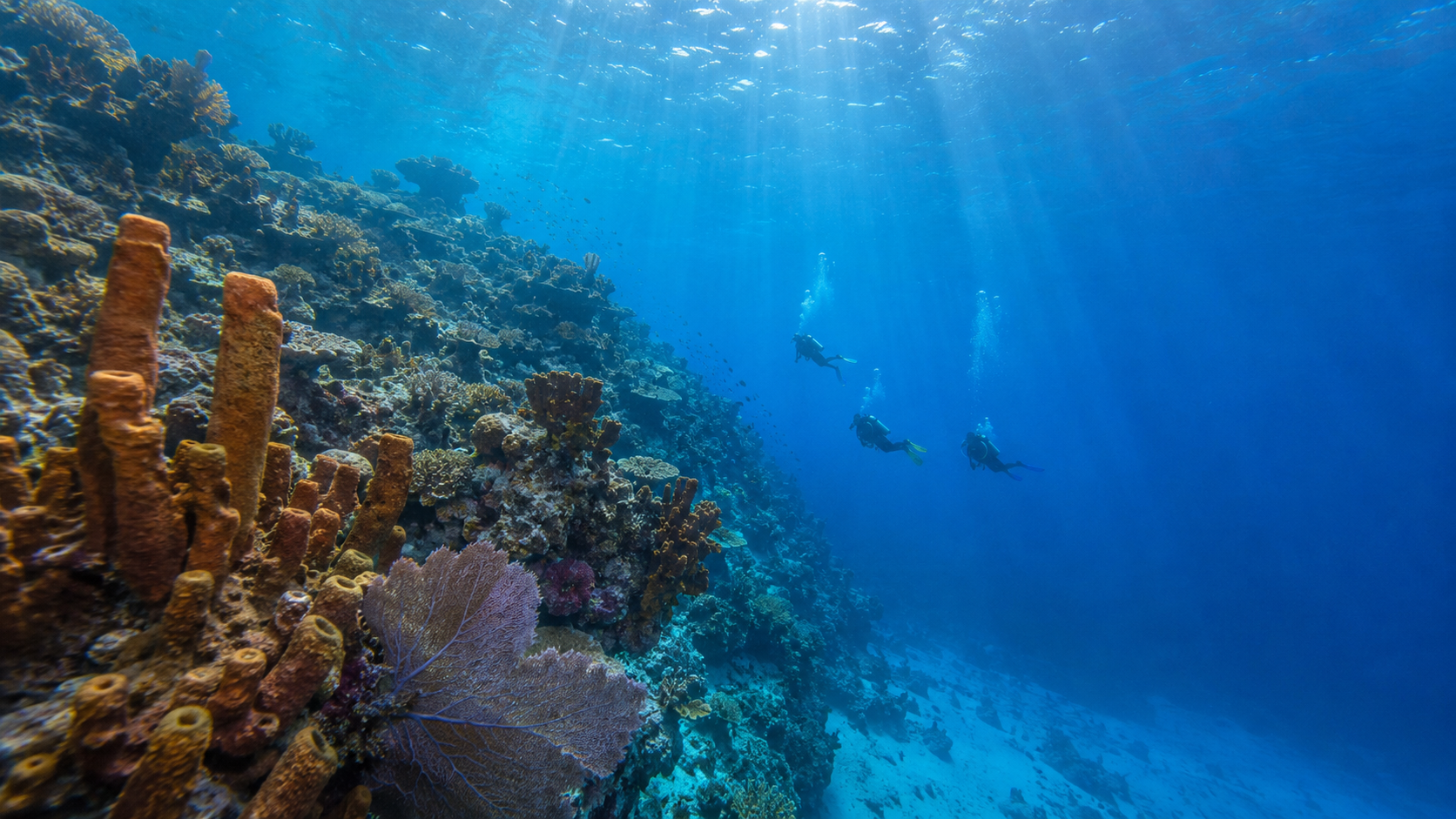
It does not care if you are new, nervous, distracted, task-loaded, overweighted, underweighted, filming, checking your computer, or trying to keep up with the group. If you kick coral, kneel on it, drag a gauge across it, or drop onto it, the result is still damage.
Intentions do not protect the reef.
Skill does.
That does not mean every new diver is reckless. Most divers I meet genuinely care. They do not want to touch coral. They do not want to damage anything. But wanting to avoid contact and having enough control to avoid contact are not the same thing.
That is where buoyancy becomes an environmental skill.
It is how respect becomes physical. It is how “I care about the reef” turns into “my fins are clear, my hands are still, my gear is tucked in, and I am not landing on the bottom every time I stop moving.”
That matters to me more now than it did when I started.
The ocean deserves more than good intentions.
Trim and Buoyancy Are Connected
Buoyancy is not only about whether you sink or float.
It is also about how your body sits in the water.
If my feet are low and my head is high, I am creating drag. I may be kicking downward without realizing it. I may be stirring up sand, working harder than necessary, or putting my fins closer to the reef than they need to be.
When trim is flatter and more balanced, everything gets easier.
Movement becomes cleaner. Kicks become more efficient. Stops become less dramatic. It is easier to hover without tipping, rising, or dropping. Even small things, like looking at a fish or checking a camera, feel less disruptive because my body is not constantly trying to roll or pivot out of position.
This is where gear, weighting, tank position, breathing, and body awareness all come together.
A diver can be neutrally buoyant and still trimmed poorly. A diver can also have decent trim but be constantly adjusting buoyancy because the weighting or breathing rhythm is off.
The goal is not to solve one piece in isolation.
The goal is to make the whole system work together.
Weighting Matters More Than People Think
A lot of buoyancy problems start before the dive begins.
If I am overweighted, I need more air in the BCD to compensate. That bigger air bubble expands and compresses more as depth changes, which means more adjustments and more buoyancy swing throughout the dive.
If I am underweighted, I may struggle to descend or hold a safety stop, especially near the end of the dive when the tank is lighter.
Neither problem feels good underwater.
Weighting is not about sinking. That is the beginner trap. The goal is not to drop like a rock at the beginning of the dive. The goal is control across the whole dive.
Saltwater versus freshwater matters. Wetsuit thickness matters. Tank type matters. Boots, fins, body composition, exposure layers, and even how much gas is left in the cylinder matter.
This becomes even more obvious when traveling.
A setup that feels right in one place may need adjustment somewhere else. A 3mm wetsuit in warm saltwater is not the same as thicker exposure protection in colder conditions. Aluminum tanks behave differently through the dive than steel tanks. Small changes can show up quickly once you are in the water.
The more I dive, the more I treat weighting as part of the plan, not just something to guess at on the boat.
Breathing Is Buoyancy Control
The BCD is not the only buoyancy tool.
My lungs matter too.
That sounds obvious after you have been diving for a while, but it is one of those things that takes time to actually feel. A slow inhale can lift me slightly. A slow exhale can let me settle. That does not mean holding my breath, which is never the answer. It means breathing rhythm is part of fine control.
This is one reason stress and buoyancy are so connected.
If my breathing gets fast and shallow, my buoyancy gets harder to manage. I start moving more. I start correcting more. I burn more gas. Then I feel less stable, which can make my breathing even worse.
It can become a loop.
The better version of that loop works in the other direction. Calm breathing helps buoyancy. Better buoyancy helps me stay calm. Less effort means slower breathing. Slower breathing supports better control.
When that loop is working, the whole dive feels better.
Perfect Buoyancy Helps Gas Consumption
No specialty magically fixes air consumption.
I do not think about buoyancy that way. But I do think buoyancy is one of the biggest pieces of the gas-consumption puzzle.
If I am constantly kicking, sculling with my hands, adjusting my BCD, changing depth, and fighting my trim, I am working harder than I need to. Harder work usually means more gas use.
Better buoyancy lowers the workload.
That does not mean I suddenly breathe like a diver with thousands of dives. It just means I am not wasting as much energy fighting the water.
Small improvements matter here.
A little less hand movement. A little better trim. A little calmer breathing. A little less overcorrection. A little more patience before adding or dumping air.
Those things add up.
Better buoyancy does not give me a bigger tank.
It helps me stop wasting the one I already have.
Buoyancy Makes Deep Diving Better
Deep Diving changed how I think about planning, but buoyancy is one of the skills that makes deeper dives feel controlled.
At depth, the margin for sloppy habits feels smaller. Wetsuits compress more. Gas use changes. No-decompression time matters. Ascent discipline matters. BCD adjustments matter. A descent that gets away from you can take you deeper than planned. An ascent that gets sloppy can turn into a buoyancy problem quickly as gas expands.
Good buoyancy does not replace planning.
It helps me execute the plan.
That is the difference.
A deeper dive already asks more from the diver. You are watching depth, gas, time, the computer, the buddy team, and the profile. Bad buoyancy adds noise to all of that. Good buoyancy gives some of that mental bandwidth back.
That is why Perfect Buoyancy fits so naturally after Deep Diving in my path.
Deep Diving showed me why control mattered.
Perfect Buoyancy gave me another way to work on that control.
Buoyancy Makes Video and Photos Better
I care about underwater footage, but I do not want the camera to take over the dive.
That is one reason buoyancy matters so much.
If I am bouncing up and down, the footage shows it. If I am finning constantly, the camera moves. If I am dropping every time I focus on a subject, I am not just getting bad footage. I am also creating a possible reef-contact problem.
Stable buoyancy gives me a better chance at stable footage.
It also lets the camera stay in its place.
A GoPro should not become an excuse to get too close, ignore the buddy team, drift into the reef, or stop paying attention to depth and current. The shot is not more important than the dive.
Good buoyancy helps keep that balance.
It lets me film when it makes sense and stop filming when the dive needs my attention.
That is how I want the camera to fit into my diving.
Your Hands Are Not Fins
This is one of those habits that shows up fast in new divers.
The hands start moving.
A little paddle. A little push. A little underwater balancing act.
It makes sense. On land, we use our hands for balance all the time. Underwater, that instinct follows us down. The problem is that most of the time, those hand movements are just wasted energy covering up another issue.
Maybe it is trim. Maybe it is weighting. Maybe it is breathing. Maybe it is stress. Maybe it is just not trusting the fins and lungs enough yet.
Using hands can solve the immediate feeling of instability, but it does not fix the cause.
I am not saying arms have to be locked in place like a statue. That is not the point. The point is to stop using hands as the main control system.
Fins move me.
Breathing fine-tunes me.
The BCD supports me.
Hands should not be doing all the work.
Buoyancy Is Situational
Perfect buoyancy is not something you prove once in a pool and then own forever.
Real dives are messy.
Current changes. Depth changes. Visibility changes. Task loading changes. A diver gets close. The reef rises. The bottom drops. You check your computer. You adjust the camera. You follow the guide. You hold a safety stop. You deploy an SMB. You move from wall to sand to reef and back again.
Buoyancy has to travel with you through all of that.
That is why I do not think of buoyancy as a single skill. It is more like a constant conversation with the dive.
Where am I? What is my depth doing? What happens when I stop kicking? Are my fins clear? Am I rising because I got distracted? Am I sinking because I am focused on the camera? Am I making small corrections or big ones?
A calm pool hover is useful.
But buoyancy on a real dive is where the skill becomes real.
Small Improvements Add Up
The encouraging thing about buoyancy is that you can feel improvement.
You do not need to become perfect overnight for the dive to get better. A little better weighting helps. A little slower breathing helps. A little less hand movement helps. A little flatter trim helps. A little more awareness on descent helps. A little more patience on ascent helps.
Each small improvement reduces the amount of work the next dive requires.
That is how confidence builds.
Not from one magic breakthrough, but from a bunch of small corrections that start becoming habits.
I like that part of diving.
It rewards paying attention.
What I Watch for Now
When I think about buoyancy now, I am watching more than my depth number.
Depth matters, but it is not the whole story.
| Question | Why It Matters |
|---|---|
| Am I moving more than necessary? | Extra movement burns gas and creates instability |
| Are my fins clear of the reef or bottom? | Environmental protection starts with distance |
| Am I using my hands too much? | Hands often reveal trim or balance issues |
| Am I rising when distracted? | Task loading can break buoyancy control |
| Am I dropping when filming? | Camera focus can reduce body awareness |
| Is my weighting right? | Weighting affects control through the whole dive |
| Is my breathing calm? | Breathing and buoyancy are linked |
| Can I hold a safety stop comfortably? | Ascent control is part of buoyancy skill |
That is not a formal checklist I recite underwater. It is more like the way I have started paying attention.
If the answers are calm and boring, the dive usually feels better.
Perfect Buoyancy Is Really About Awareness
The course title says buoyancy, but the deeper lesson is awareness.
Where is my body?
Where are my fins?
Where is the reef?
Where is my buddy?
What is my depth doing?
What is my breathing doing?
What happens if I stop kicking?
Am I in control, or am I reacting?
That awareness changes the whole dive.
It makes me less disruptive, less stressed, and more present. It helps me protect the reef. It helps me stay with the team. It helps me notice the actual dive instead of spending the whole time managing myself.
That is when scuba starts feeling less like a checklist and more like being underwater.
Not just surviving the environment.
Belonging in it for a little while.
What I Would Tell a New Diver
Do not wait too long to care about buoyancy.
That is the biggest thing I would say.
Do not treat it like an advanced polish skill you can get around to later. Do not assume experience alone will automatically fix it. Experience helps, but only if you are paying attention to what is happening.
Every dive can be buoyancy practice.
That does not mean beating yourself up every time you rise, sink, kick too much, or use your hands. Everyone starts somewhere. The point is to notice it and make the next dive a little cleaner.
Less contact.
Less movement.
Less fighting.
More control.
That is progress.
Final Thought
Perfect buoyancy is not optional because it connects to almost everything.
It protects the reef. It saves energy. It helps gas consumption. It improves video. It supports deeper diving. It makes safety stops calmer. It makes the whole dive feel less chaotic.
Most importantly, it changes the way I relate to the water.
Instead of pushing through it, I start settling into it.
That is when diving feels different. Not because I went deeper. Not because I bought better gear. Not because the site was famous.
Because for a few moments, I was exactly where I meant to be.
Not rising.
Not falling.
Calm enough to breathe.
Still enough to notice.
Controlled enough to leave the reef exactly as I found it.