Navigation Feels Like the Course I Should Be Ready For
Navigation is the course on this list that makes me the least nervous.
I was a Cub Scout and a Boy Scout. Maps, direction, basic orientation, and “where are we in relation to where we started?” do not feel foreign to me.
But I also know enough not to pretend land navigation and underwater navigation are the same thing.
On land, you can stop, look around, find a road, read a sign, or pull out a phone. Underwater, the whole world is moving. Visibility can change. Current can push you. Depth can mess with your sense of distance. The reef may not look the same from the other direction.
So yes, I feel good about Navigation.
I am still going to respect it.
SSI lists Navigation as one of its specialty programs, alongside Diver Stress & Rescue, Night & Limited Visibility, Deep Diving, Enriched Air Nitrox, Perfect Buoyancy, React Right, and other courses. My current certification file shows Open Water, Enriched Air Nitrox, Deep Diving, Equipment Techniques, Perfect Buoyancy, and React Right, but Navigation is not listed as completed yet.
That makes this another pre-course article.
Not a victory lap.
A look at why this course feels familiar, why that familiarity could be useful, and why it still deserves humility.
Why This Course Does Not Scare Me
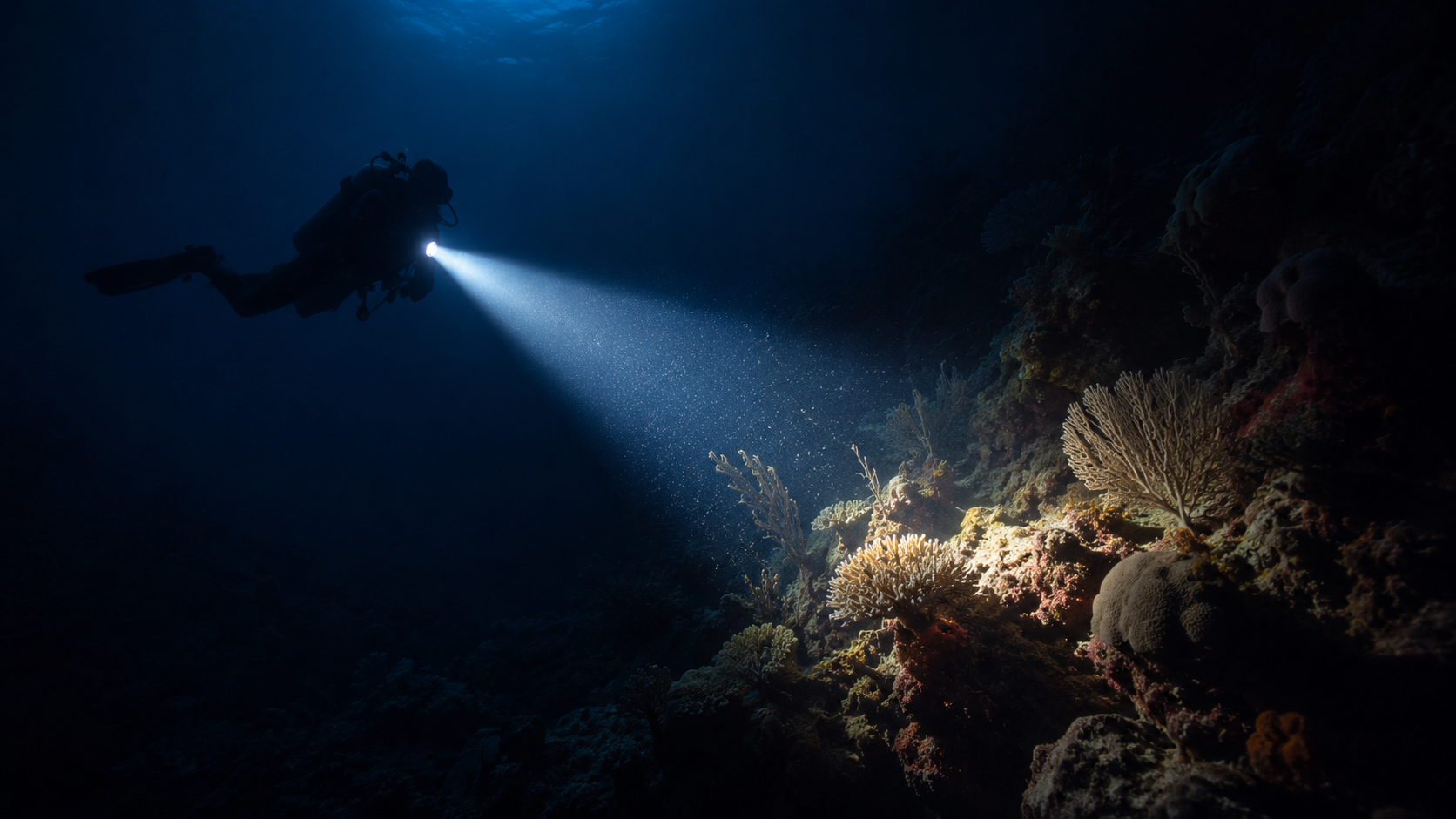
Navigation does not hit me the same way Diver Stress & Rescue or Night & Limited Visibility does.
Stress & Rescue feels heavy because it asks me to think beyond myself and pay closer attention to other divers. Night & Limited Visibility gets in my head because it reduces the amount of information I can see. Both of those courses feel like they are going to push directly against discomfort.
Navigation feels different.
I have always been comfortable with the basic idea of orientation. Where are we? Where did we start? What direction are we heading? What is the return path? What does the terrain tell us? How do we avoid wandering around just because we think we know where we are?
That kind of thinking is familiar.
Scouting gave me some of that. It does not make me an expert diver. It does not mean I can skip the work. But it does mean the mental framework does not feel foreign.
I like maps.
I like direction.
I like having a plan.
I like knowing where I am instead of just following someone else and hoping it all works out.
That is probably why Navigation feels like the course I should be ready for.
Comfort Is Not the Same as Mastery
Feeling comfortable with the idea of navigation is useful.
It is not enough.
That is the part I want to keep clear in my own head. Confidence is fine as long as it stays attached to reality. The mistake would be walking into the course thinking, “I already know this.”
I do not.
I know some concepts that may help.
That is different.
Underwater navigation has its own problems. A compass heading is not the whole dive. Distance is harder to judge. Kick cycles are not perfect. Current can push you off line. Depth changes can distract you. Reef structure can pull your attention. Visibility can make a familiar route feel unfamiliar. Task loading can make you forget something basic.
On land, you can pause and reset in a very different way.
Underwater, stopping is still part of the dive. You are still breathing gas. You are still managing buoyancy. You are still staying with a buddy. You are still tracking time, depth, current, and the plan.
That changes the feel of the skill.
So yes, I am confident.
But I am not casual about it.
Underwater Landmarks Are Different
One of the biggest differences is landmarks.
On land, landmarks are usually obvious. Roads, buildings, signs, trails, tree lines, ridges, fences, rivers, and intersections all help you understand where you are.
Underwater, landmarks can be less obvious, especially if you are not trained to notice them.
A coral head may look different from another angle. A reef channel may seem clear on the way out and disappear into sameness on the way back. Sand patches, rubble fields, slopes, swim-throughs, and wall features can all blur together if you are not paying attention.
And unlike land, the environment itself is not still.
Current can move you. Surge can shift your position. Visibility can change. Other divers can stir things up. A camera can distract you. Marine life can pull your focus. The guide can change direction. The site may not look the way you pictured it from the briefing.
That is why navigation underwater is not just compass work.
It is observation.
It is memory.
It is awareness.
It is discipline.
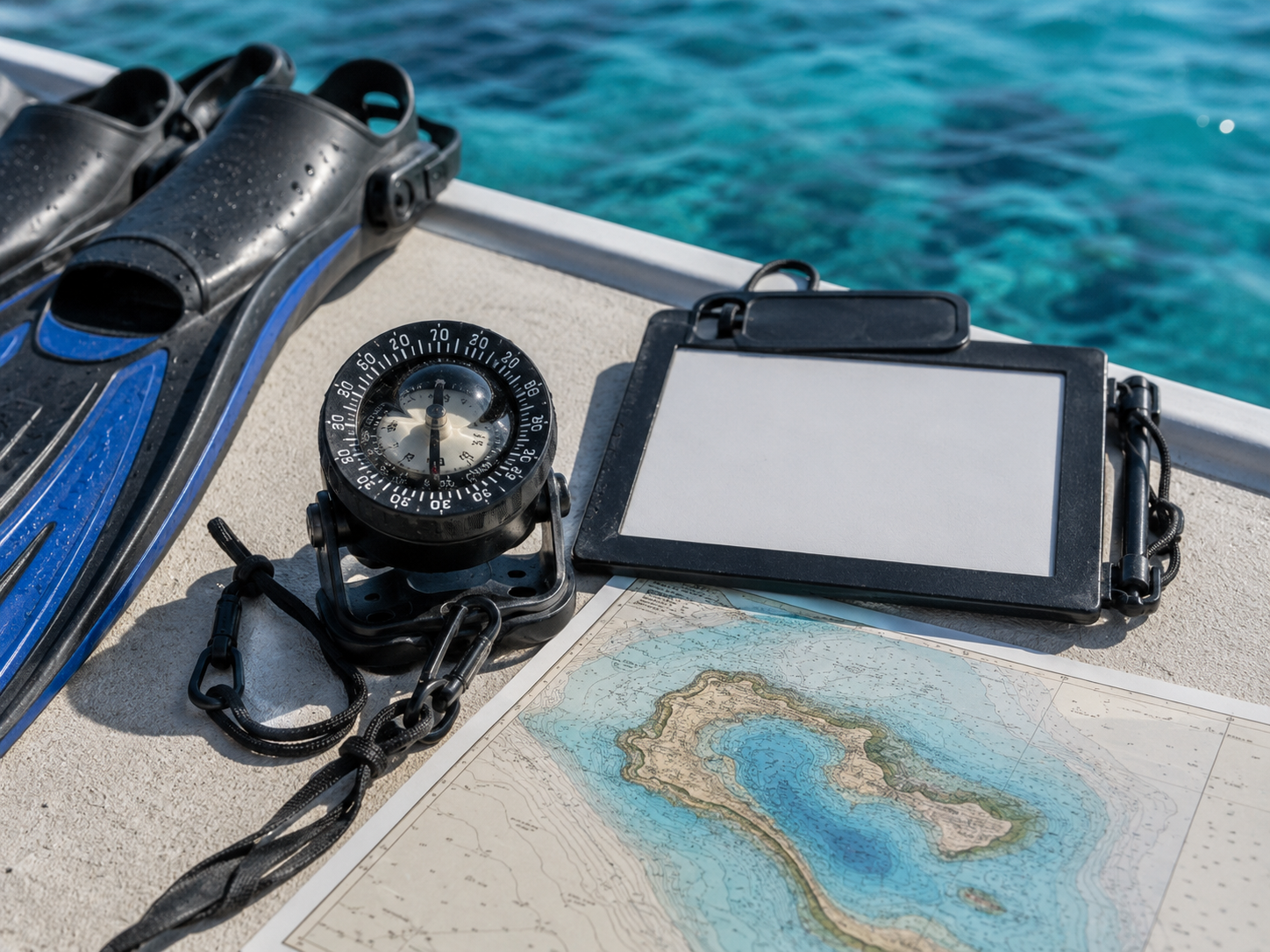
The compass matters, but the compass is not the whole skill.
Guided Divers Still Need Navigation Awareness
A lot of recreational diving is guided, especially on travel trips.
That can make it easy to become passive.
The guide gives the briefing. The guide knows the site. The guide leads the dive. The guide handles the route. The guide knows where the boat should be. The guide knows when to turn.
That is convenient, but it can become a bad habit if I stop thinking for myself.
I do not want to be the diver who has no idea where he is because he assumes someone else always has it covered.
Even on a guided dive, I should be paying attention.
Where did we descend?
What direction did we start moving?
Is the reef on my left or right?
Is the current pushing with us or across us?
Are we gradually getting shallower or deeper?
Did we turn, drift, circle, or move along a line?
Where is my buddy in relation to me?
If we had to end the dive early, what would the situation probably look like?
That does not mean I am trying to take over the guide’s job. It means I am trying to be an active diver instead of cargo with fins.
There is a difference.
Know Where You Are, Not Just Who You Are Following
This is the heart of it for me.
I do not want my only navigation plan to be “follow the person in front of me.”
Following the guide is part of the dive. It is not a complete awareness strategy.
Knowing where I am gives me a better relationship with the dive site. It helps me understand the briefing. It helps me anticipate what is happening. It helps me stay calmer if the group shifts or visibility changes. It also makes me a better buddy because I am not completely dependent on someone else’s awareness.
That matters even more as the dives get more complex.
Walls.
Wrecks.
Drift dives.
Limited visibility.
Night dives.
Multi-level profiles.
Boat dives where the exit may not be exactly where the descent started.
The more variables a dive has, the more useful navigation awareness becomes.
I do not need to be the world’s greatest underwater navigator.
But I do need to know enough to not be passive.
Current Changes the Math
Current is one of the reasons underwater navigation deserves respect.
On land, if I walk north, I generally go north unless I turn. Underwater, I can aim one direction and still be moved by the water. That changes everything.
A heading is still useful, but it does not automatically guarantee the path. Current can push a diver off course slowly enough that they do not notice until the route feels wrong. It can also make the return trip harder than expected if the original direction was not planned well.
That is why navigation has to connect with site conditions.
What is the current doing?
Is it steady or shifting?
Are we drifting with it or crossing it?
Is the return route realistic?
Are we navigating back to a fixed point, or is this a drift profile where the boat pickup is part of the plan?
Those are not abstract questions.
They affect the actual dive.
This is where Navigation connects naturally with other skills like Waves, Tides & Currents, Night & Limited Visibility, and Dive Guide-level thinking. SSI lists all of those within its broader specialty and professional pathways.
The more I progress, the less these courses feel separate.
They start stacking into one bigger skill: understanding the dive as it is happening.
Visibility Changes Navigation Too
Good visibility makes navigation easier because it gives you more information.
Limited visibility takes that away.
That is one reason Navigation and Night & Limited Visibility feel connected in my mind. In clear water, I can use the reef shape, light direction, group position, and distance cues more easily. When visibility drops, those cues shrink. The compass matters more. Buddy position matters more. communication matters more. The plan matters more.
That does not mean navigation only matters in poor visibility.
It means poor visibility reveals whether the navigation habits were really there.
If I only know where I am because I can see everything, I may not be as aware as I think I am.
That is the part I want to work on.
I want navigation to become more than a good-weather skill.
Task Loading Can Break Orientation
Another thing I respect is task loading.
It is easy to say, “Just follow the compass,” when that is the only thing happening.
But underwater, that may not be the only thing happening.
You may be watching depth, checking gas, managing buoyancy, staying with a buddy, avoiding coral, listening to a rattle or tank banger, watching the guide, adjusting to current, clearing a mask, handling a camera, or trying to remember the site briefing.
That is when orientation can slip.
Not because the diver is stupid.
Because the diver is busy.
Good navigation habits have to survive that busyness. They need to be simple enough, practiced enough, and calm enough to work when the dive is not perfectly clean.
That is one thing I hope this course helps with.
Not just knowing how to use a compass.
Knowing how to keep orientation while still diving well.
How Navigation Helps Future Guide Work
Navigation matters even more if I am serious about the guide path.
SSI’s professional path includes Dive Guide and Divemaster in the lead/professional progression. That does not mean I am there yet, but it does shape how I look at the courses ahead.
A guide-level diver needs more than personal comfort.
They need site awareness.
They need to understand briefings.
They need to anticipate how a dive might flow.
They need to track group movement, not just personal movement.
They need to understand how current, reef shape, entry point, exit plan, and visibility affect the dive.
Navigation supports all of that.
It makes a diver less passive and more useful. It helps with buddy confidence. It helps with understanding what the guide is doing instead of just following the bubbles ahead. It also helps build the kind of awareness that makes future professional training feel more grounded.
I do not think Navigation makes someone a guide.
But I do think a future guide should care about Navigation.
Better Briefings Start Making More Sense
One thing I expect from this course is that dive briefings will become more useful.
A good briefing gives you a lot of information: site layout, depth range, expected route, current, entry, exit, points of interest, turn pressure, hazards, and what to do if separated.
Newer divers may hear all of that and only catch the big pieces.
Depth.
Time.
Follow the guide.
Stay with your buddy.
Do a safety stop.
As navigation awareness improves, the rest of the briefing starts to matter more. The shape of the reef matters. The direction of travel matters. Whether the current is pushing north or south matters. Whether the boat is moored or following bubbles matters. Whether the dive is out-and-back, circular, drift, or wall-based matters.
I want to understand those details better.
Not just as information.
As part of the dive plan.
The Humility Piece
This is where I need to be honest with myself.
Navigation is the course I feel most confident about, and that is exactly why it deserves humility.
Confidence can help. It can make me more willing to engage with the skill, ask better questions, and practice deliberately.
Arrogance is different.
Arrogance is where mistakes start.
Arrogance says, “I already know this.”
Arrogance skips the briefing.
Arrogance assumes the reef will look the same on the way back.
Arrogance stops checking the compass because the direction feels obvious.
Arrogance follows a hunch instead of the plan.
That is not the kind of diver I want to be.
I can bring my scouting background into this course without pretending it makes me immune to underwater mistakes. The goal is not to prove I am naturally good at navigation.
The goal is to become more reliable.
That is a better standard.
What I Want From the Course
What I want from Navigation is pretty straightforward.
I want to build better orientation underwater. I want to understand compass use more clearly. I want to connect natural navigation with actual dive planning. I want to get better at judging distance, direction, reef shape, and return routes. I want to listen to dive briefings with more context.
I also want to be a better buddy.
A buddy who knows where we are is more useful than a buddy who is just present. A buddy who is paying attention to route, current, and group position can help keep the team calmer if something changes.
That matters to me.
Not because I expect every dive to go wrong.
Because I want to be more useful if it does.
What I Do Not Want to Do
I do not want to treat Navigation like an easy card.
That would be the wrong attitude.
I do not want to assume land skills transfer perfectly underwater. I do not want to ignore current. I do not want to rely only on the guide. I do not want to confuse confidence with competence. I do not want to stop paying attention just because the site feels simple.
Most of all, I do not want to drift through dives without understanding where I am.
That is the habit I want to break before it ever becomes normal.
Final Thought
Navigation feels like the course I should be ready for.
That is good.
It also means I need to take it seriously.
My scouting background gives me comfort with maps, direction, and basic orientation, but underwater navigation adds a completely different environment. Current moves you. Visibility changes. Depth affects perception. The reef does not always look the same from both directions. Task loading can make simple things harder.
So I am going into Navigation with confidence.
But not arrogance.
I want to know where I am, not just who I am following. I want to understand dive briefings better. I want to be more useful to my buddy. I want better site awareness. I want another piece of the guide-path mindset.
The course does not scare me.
That does not mean I plan to underestimate it.