Behind the Visor: Learning to Dive a Full Face Mask
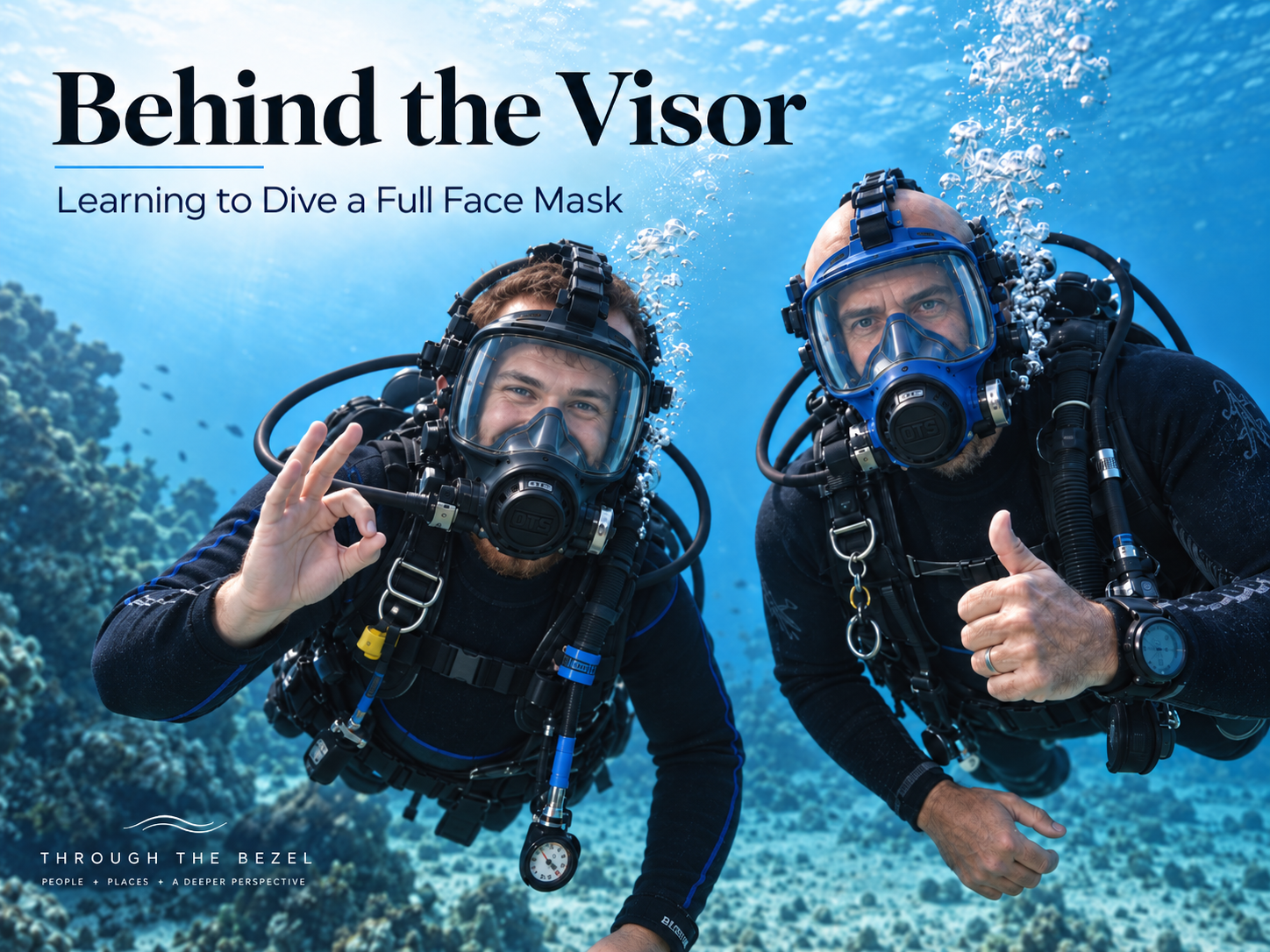
Today, Shawn and I completed the SSI Full Face Mask Diving specialty.
On paper, that sounds simple enough. Put on a different mask, breathe through it, learn a few new procedures, make a couple of dives, and add another certification to the logbook.
That really isn’t what the class is about.
We already know how to scuba dive. We know how to clear a mask, recover a regulator, equalize, control our buoyancy, monitor our gas, communicate with a buddy, and respond when something doesn’t go according to plan.
A full-face mask takes some of those very familiar skills and changes the way you perform them.
That is what made this class interesting.
The goal wasn’t simply learning how to breathe underwater while wearing a bigger mask. It was learning an entirely different interface between the diver and the life-support system.
More Than a Mask
A conventional recreational scuba setup keeps two very important pieces of equipment separate.
Your mask lets you see.
Your regulator lets you breathe.
If your mask floods or comes off, you may not be able to see particularly well, but your regulator is still in your mouth and you can still breathe.
A full-face mask changes that relationship.
The mask covers your eyes, nose, and mouth, and the regulator is incorporated into the mask itself. Instead of placing a second-stage regulator between your teeth, you’re breathing inside the mask.
That means the mask is no longer just something sitting on your face.
It has become part of your breathing system.
And once you understand that, the reason for taking an actual Full Face Mask Diving course becomes pretty obvious.
Meet the OTS Guardian
Shawn and I are diving the Ocean Technology Systems Guardian Full Face Mask, or OTS Guardian.
At first glance, the Guardian looks complicated. There is a lot more going on than a skirt, lens, and strap.
Once you break it down, though, the individual parts make sense.
The visor
The most obvious difference is the large visor.
Instead of a normal dive mask covering only your eyes and nose, the Guardian encloses your entire face. The visor provides a broad field of view while the breathing system circulates gas through the mask.
The Guardian is also designed so incoming gas moves across the visor, helping prevent fogging without the normal ritual of treating a mask with defog before every dive.
That is a small thing, but I am perfectly happy eliminating one more bottle from the dive bag.
The face seal
Around the Guardian is a one-piece silicone skirt with a double face seal.
That seal matters because the mask has to do more than keep water away from your eyes. It has to maintain the enclosed space you’re breathing from.
Proper fit matters with any dive mask.
With a full-face mask, fit becomes part of the breathing system.
The five-point harness
A traditional mask usually has one strap.
The Guardian uses a five-point head harness.
There is a reason for that.
With a conventional mask, accidentally knocking the mask loose is inconvenient.
With a full-face mask, you have potentially disrupted your primary breathing system.
The harness spreads tension around the head and keeps the mask securely positioned against the face.
It also means putting the mask on and adjusting it correctly is a little more deliberate than pulling a normal mask strap over your head.
The integrated second stage
This is where the Guardian stops being just a mask.
The second-stage regulator attaches directly to the mask and connects to the first stage using a standard low-pressure scuba hose.
There is no regulator mouthpiece to bite down on.
You breathe normally inside the mask.
That means you can breathe through your mouth or your nose.
It sounds like a minor difference until you have spent your entire scuba career conditioned to breathe exclusively through a regulator in your mouth.
Then somebody suddenly gives your nose permission to participate again.
The Ambient Breathing Valve
One of my favorite little pieces of the system is the Ambient Breathing Valve, usually shortened to ABV.
When you’re on the surface, there is no reason to sit there consuming cylinder gas while waiting to descend.
Open the ABV and you breathe the surrounding air.
Before going underwater, close it and the mask returns to breathing from the scuba system.
Simple.
Useful.
And absolutely something you want to remember before descending.
The oral-nasal pocket
Inside the Guardian is an oral-nasal pocket around your nose and mouth.
It isn’t just padding.
It helps manage airflow inside the larger mask volume and separates inhaled and exhaled gas.
Once again, we’re getting farther away from the idea that this is simply a giant scuba mask.
There is an actual breathing system inside it.
The equalization block
Then there is the part that probably generates the most immediate question from someone seeing a Guardian for the first time:
How do you pinch your nose?
You don’t. At least not directly.
The Guardian has an adjustable equalization block positioned inside the mask. Instead of physically reaching up and pinching your nostrils with your fingers, you position the mask so the block closes the nose when you need to equalize.
Because everyone’s face is different, the equalization system has to be adjusted to the diver.
That makes proper setup particularly important.
Too far away and you can’t effectively block your nose.
Too close and you’ve basically installed something inside your mask whose primary purpose is to annoy you.
When adjusted correctly, it becomes another procedure that eventually feels normal.
Learning to Breathe Differently
One of the strangest things about full-face-mask diving is that breathing feels both incredibly familiar and completely different.
You’re still breathing compressed gas from the same cylinder.
The first stage is still doing its job.
The second stage is still delivering gas on demand.
But the final interface is completely different.
There is nothing in your mouth.
No mouthpiece.
No biting down.
No jaw fatigue from holding a regulator.
You’re simply breathing inside the mask.
After learning to scuba dive and developing the habit of breathing through a regulator, being able to breathe naturally through your nose underwater almost feels like you’re doing something you’re not supposed to be doing.
Your brain eventually catches up.
Familiar Skills, Different Procedures
This is where the Full Face Mask specialty earns its keep.
The normal operation of a full-face mask isn’t particularly intimidating.
Put it on correctly, make sure everything is connected and functioning, descend, equalize, breathe, dive.
The important training begins when everything isn’t functioning normally.
SSI’s Full Face Mask Diving specialty includes equipment preparation, fit, breathing, equalization, mask handling, clearing, and emergency procedures. The training begins in confined water before moving into open water because these aren’t procedures you want to invent for the first time while something is actually wrong.
That becomes especially important because of the difference between a conventional mask and a Guardian.
If I remove my regular scuba mask underwater, I’m still breathing from the regulator in my mouth.
If I remove the Guardian, I just removed my primary second stage along with it.
Now another breathing source has to be established.
That changes things.
The Backup Mask Isn’t an Afterthought Anymore
This class also changed the way I look at one very ordinary piece of scuba equipment:
the backup mask.
I’ve always understood why carrying one could be useful.
With the Guardian, its role becomes much easier to appreciate.
If a situation requires transitioning completely out of the full-face mask, the basic sequence becomes establishing another breathing source, removing the Guardian, deploying a conventional mask, getting stable, and deciding what happens next.
That doesn’t mean every little problem with a Guardian requires ripping the thing off your head.
Far from it.
The point of training is learning what problems can be corrected while wearing the mask and what circumstances require another response.
But if you actually need the Guardian off your face, suddenly knowing exactly where your backup mask is stored becomes fairly important.
Which also explains why I’ve been looking for a better way to carry one securely on my Mares Bolt SLS instead of simply finding somewhere to stuff it.
Sometimes training exposes a new gear problem.
At least this one is relatively easy to solve.
Communications Are There, But That Wasn’t the Point
One of the capabilities that attracts people to full-face masks is underwater communication.
The Guardian includes a communications port and can be configured with OTS underwater communication equipment.
We haven’t gone down that road yet.
And I actually think that’s important.
It would be easy to look at a full-face mask, see the communications capability, and decide that talking underwater is the interesting part.
For us, today’s class was about something much more fundamental:
Learn to safely dive the mask first.
Before worrying about microphones, earphones, Buddy Phones, or conversations underwater, I want the basic operation of the Guardian to become routine.
Communication can come later.
And knowing me, it probably will.
What Actually Changed?
The easiest way to describe full-face-mask diving is that most of scuba is still scuba.
Buoyancy still matters.
Gas management still matters.
Depth still matters.
Your computer still matters.
Your buddy still matters.
Situational awareness still matters.
The ocean certainly doesn’t care what kind of mask you’re wearing.
What changed is the interface.
With a conventional setup, my mask and regulator are independent.
With the Guardian, they function together.
With a conventional setup, I reach up and pinch my nose.
With the Guardian, I use the equalization block.
With a conventional setup, the regulator is in my mouth.
With the Guardian, I’m simply breathing inside the mask.
With a conventional setup, losing the mask primarily affects my vision.
With the Guardian, removing the mask means I also need another breathing source.
None of those differences are particularly terrifying.
But they’re different enough that training matters.
Was the Specialty Worth It?
Absolutely.
Not because we needed another certification card.
And not because I think every recreational diver needs to run out and buy a full-face mask.
They don’t.
For someone planning to dive a Guardian, though, the training makes sense.
Buying equipment and understanding equipment are not the same thing.
A full-face mask is a particularly bad piece of equipment on which to discover that difference underwater.
The SSI course gave Shawn and me the opportunity to work with the masks as systems instead of simply wearing them as equipment.
That is the real value.
I don’t just want to know how the Guardian works when everything is going perfectly.
I want the normal operation to become routine enough that I have mental bandwidth available when something isn’t perfect.
That is really what scuba training is supposed to accomplish.
Behind the Visor
When we star