My SSI Progression Plan: From Open Water to Master Diver
It is easy for scuba progression to turn into a checklist.
You finish a course, get the card, log a few dives, and start looking at the next box to check. There is nothing wrong with having goals. I like having goals. But that version of progression can get shallow fast if the training never changes how you actually dive.
That is not how I want to approach SSI progression.
For me, the point is not to collect certifications just because they exist. The point is to build capability that shows up in the water. I want better buoyancy, better gas awareness, better comfort at depth, better gear familiarity, better buddy awareness, and better judgment when a dive does not go exactly the way it looked on paper.
The card matters, but only if the work behind it changes the diver holding it.
That is the lens I am using for my path from Open Water to Master Diver.
Where the SSI Path Starts
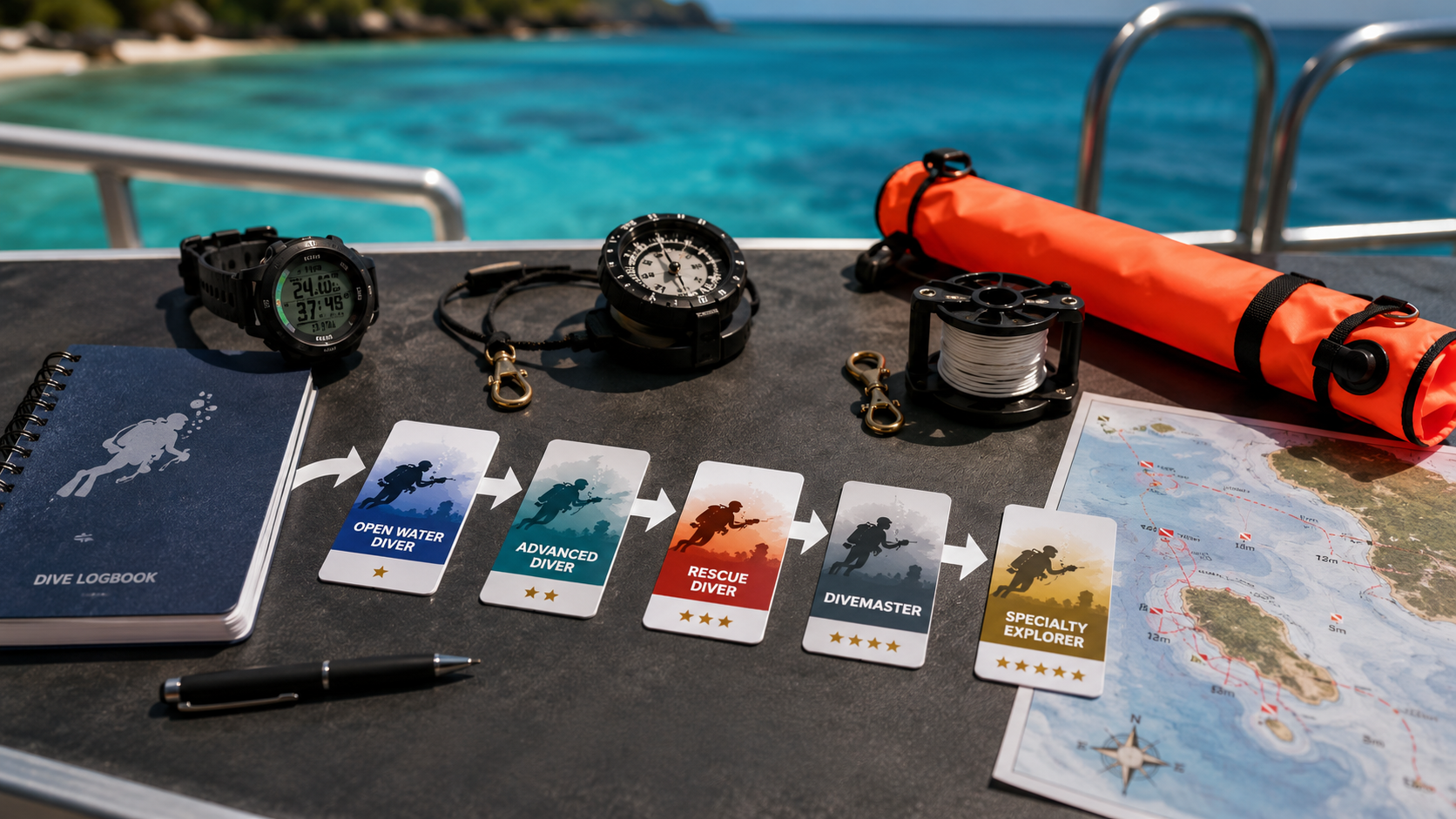
SSI’s recreational pathway gives divers a pretty clear progression structure. It starts with Open Water Diver as Level 1, then moves through Specialty Diver, Advanced Open Water Diver, Master Diver, and later experience recognition levels like Century 100 Diver, Bronze 200 Diver, Silver 300 Diver, Gold 500 Diver, Platinum 1000 Diver, and Platinum Pro 5000 Diver.
I like that structure because it separates two different kinds of growth. There is training recognition, which is about courses, specialties, and skill development. Then there is experience recognition, which is about logged dives and time spent underwater.
Both matter.
A diver with training but not much experience still has a lot to learn. A diver with a lot of dives but no continued training may have gaps they do not notice. The better path is not just more cards or more dives. It is both working together.
That is what I am trying to build toward.
Where I Am Right Now
My SSI path already has a solid foundation. I am not starting from zero, but I am also not pretending I am finished.
So far, I have completed:
| Course | Date |
|---|---|
| Open Water Diver | Jan 7, 2025 |
| Enriched Air Nitrox Level 2, 40% | Feb 11, 2025 |
| Deep Diving | Apr 21, 2025 |
| Equipment Techniques | Jul 12, 2025 |
| Perfect Buoyancy | Jan 19, 2026 |
| React Right | Feb 15, 2026 |
My dive file also shows 27 completed dives as of the last update.
That is the useful part of tracking progression. It keeps the plan grounded in reality. Instead of looking at a generic course catalog and guessing what sounds interesting, I can look at what I have actually done, what skills I have already built, and what gaps still matter.
Right now, the biggest gaps are not random specialties. They are Stress & Rescue and more logged dives.
That is a good place to be. It means the next phase has a purpose.
What I Already Have Covered
The specialties I already have were not chosen at random. Looking back at them together, they form a pretty strong recreational base.
Enriched Air Nitrox was one of the first courses that changed how I thought about dive planning. It made gas mix, computer settings, no-decompression limits, and repetitive diving feel more concrete. For warm-water trips with multiple two-tank mornings, Nitrox is not just a nice extra. It becomes part of the planning conversation.
Deep Diving changed the way I look at depth. Before taking it, depth can feel like a number divers talk about. After taking it, depth feels more like a planning problem. Gas goes faster. No-decompression time tightens up. Buoyancy matters more. The ascent deserves more attention. Deep Diving made me more conservative, not less.
Equipment Techniques connected the gear to the dive in a more practical way. Regulators, BCDs, computers, gauges, exposure protection, SMBs, reels, and basic inspection habits all matter more once you own and travel with your own kit. You do not need to become a technician, but you should not be helpless with your own equipment either.
Perfect Buoyancy may be one of the most important practical courses in the whole stack. It affects everything: reef protection, gas consumption, trim, video, safety stops, deeper dives, and general comfort. Good buoyancy makes everything else easier. Bad buoyancy makes even simple dives busier than they need to be.
React Right adds the emergency response layer. It does not replace Stress & Rescue, but it does give a first-aid and emergency care foundation that fits naturally before more safety-focused dive training.
Taken together, those courses are not just badges. They each solve a real diving problem.
Why Specialty Diver Is Already Behind Me
SSI’s Specialty Diver recognition requires Open Water Diver, at least 12 logged dives, and two specialty certifications.
Based on my current file, I am already beyond that threshold. I have Open Water, more than two specialties, and more than 12 logged dives.
So Specialty Diver is not really the next meaningful target. It is already covered by the path I have taken.
That moves the question forward.
The real question now is not, “How do I get to Specialty Diver?”
The real question is, “What training makes me a better diver from here?”
Advanced Open Water Diver Is the Current Milestone
SSI’s Advanced Open Water Diver recognition works differently than some divers expect, especially if they are used to how other agencies structure the term “Advanced Open Water.”
For SSI, Advanced Open Water Diver is a recognition milestone. The recognition file shows that it requires Open Water Diver, four SSI Specialty programs, and at least 24 logged dives. Stress & Rescue is strongly recommended, but it is not required for that specific recognition level.
Here is the simple version:
| Requirement | SSI Advanced Open Water Diver |
|---|---|
| Base certification | Open Water Diver |
| Specialty certifications | 4 SSI Specialty programs |
| Logged dives | At least 24 |
| Stress & Rescue | Strongly recommended, but not required for this recognition level |
Based on my current file, I have more than four SSI specialties and 27 logged dives.
So in SSI terms, the Advanced Open Water Diver recognition should be within reach or already met, depending on how SSI has processed the recognition in the system.
That matters because it changes the way I think about the next step. I am not trying to chase “advanced” as a label. I am looking at what actually builds capability.
The recognition is useful. The training behind it is more useful.
The Next Big Target: Master Diver
The next major milestone is Master Diver.
That one feels more meaningful to me because it is not just a recognition I stumble into by taking a few interesting courses. It requires a broader mix of training and experience.
SSI’s Master Diver recognition requires Advanced Open Water Diver, Stress & Rescue, five specialty certifications, and at least 50 logged dives.
Here is where I stand against that:
| Requirement | My Status |
|---|---|
| Advanced Open Water Diver | Likely met or within reach based on specialties and dives |
| Five specialties | Met based on current certifications |
| Stress & Rescue | Still needed |
| 50 logged dives | Not yet, based on 27 logged dives |
| React Right | Completed, useful foundation |
That leaves two obvious gaps: Stress & Rescue and more logged dives.
Honestly, I like that. It means the next phase is not about stacking random specialties just to make the profile look better. It is about becoming a more capable, more experienced diver.
That feels like the right kind of progress.
The Real Next Step Is Stress & Rescue
Stress & Rescue is the next course that makes sense.
Yes, it matters for the Master Diver recognition, but that is not the only reason it belongs next. Most early scuba training is focused inward. Can I clear my mask? Can I control my buoyancy? Can I manage my gas? Can I equalize? Can I stay calm? Can I follow the plan?
Stress & Rescue starts widening that view.
Now the question becomes: how is my buddy doing? Is someone getting task loaded? Is someone breathing too fast? Is the group spreading out? Is a small problem starting to turn into a real one? What does stress look like before it becomes panic?
That is a different kind of diving maturity.
React Right already gives me a first-aid and emergency response foundation. Stress & Rescue would connect that mindset directly to the dive environment. For Master Diver, it checks a box. For actual diving, it is just the right next step.
Why Navigation Still Belongs on the List
Navigation is not required for SSI Advanced Open Water Diver in the way some divers might expect, but I still think it belongs in my progression.
SSI includes Navigation among its specialty programs.
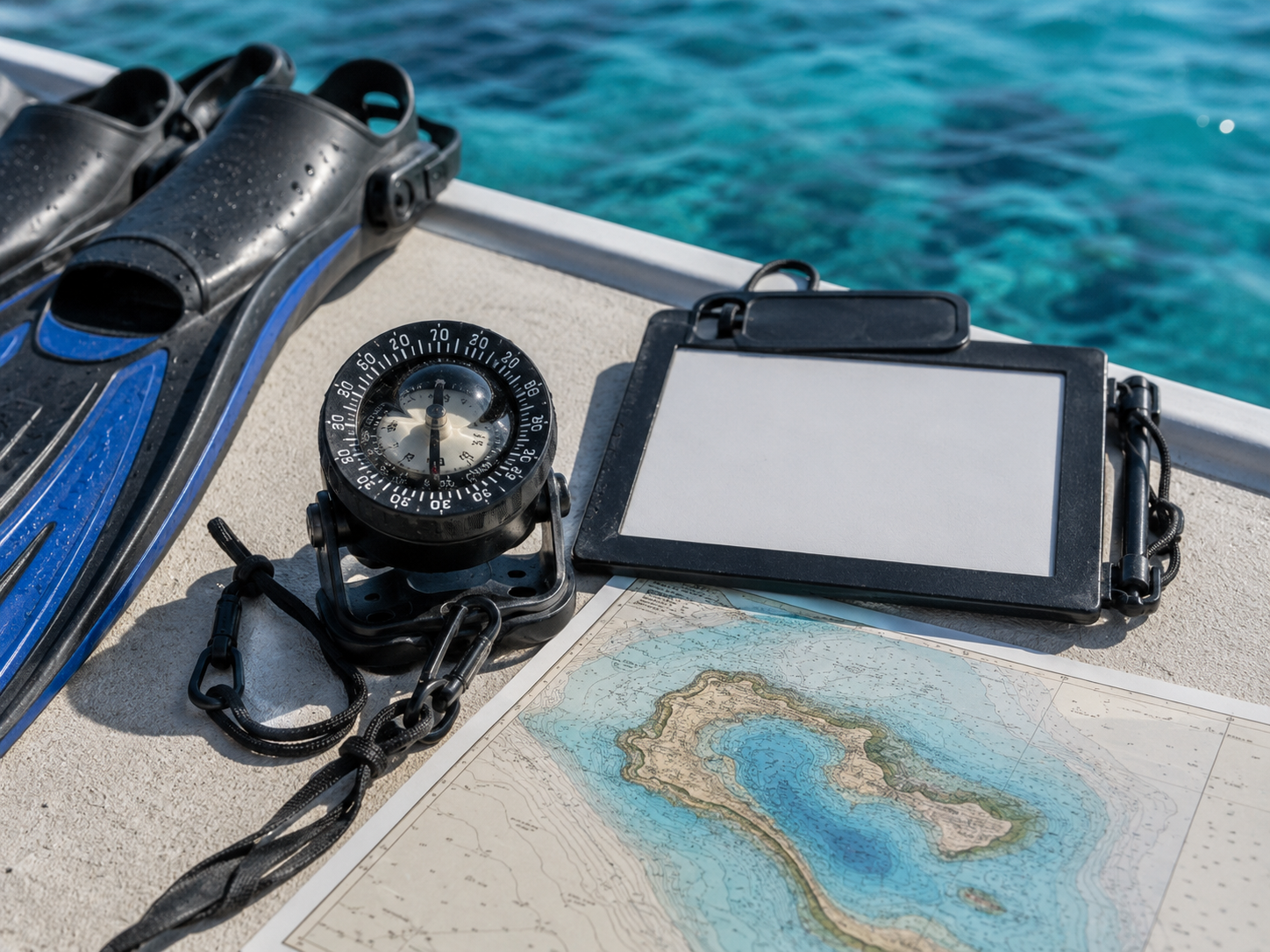
For the kind of diving I want to do, navigation matters because confidence underwater is not only about depth and buoyancy. It is also about orientation.
Where did we start? Where is the reef line? Which direction is the current moving? Where is the boat likely to be? What does the exit plan look like? How do I keep track of the dive when visibility changes or when the site is unfamiliar?
Even on guided dives, I do not want to be passive about where I am.
That does not mean I need to become a compass wizard overnight. It just means I want to be more aware, more useful to my buddy, and less dependent on someone else doing all the thinking.
That is the practical value of Navigation for me.
Waves, Tides & Currents Fits My Travel Style
I also think Waves, Tides & Currents belongs high on the list.
SSI includes it as a specialty program, and it fits the kind of diving I either already enjoy or plan to do more often.
Cozumel drift dives. Cabo conditions. Boat dives. Wall dives. Surge. Changing visibility. Surface movement. Current that may be helpful, annoying, or something you need to respect from the start.
Current is not automatically a problem. Some of my favorite dive experiences are tied directly to moving water. But current does change the dive. It affects gas use, group spacing, entry and exit strategy, buoyancy, camera control, and how much attention you need to pay to the guide and your buddy.
The more I travel for diving, the more I want to understand water movement instead of just reacting to it.
That makes Waves, Tides & Currents feel useful, not theoretical.
Wreck Diving Is Interesting, But I Would Treat It Carefully
Wreck Diving is on my interest list, but it is one of those specialties I would want to approach with discipline.
SSI includes Wreck Diving and Advanced Wreck Diving among its specialty programs.
The important distinction for me is this: recreational wreck diving is not the same as wreck penetration.
I am interested in wrecks as history, structure, navigation, and dive experience. A wreck can be one of the most memorable kinds of dives because it gives the site a story. It is not just reef and water. It is an object with a past.
But overhead environments change the risk profile. If there is no direct vertical access to the surface, that is a different kind of dive. It requires the right training, the right equipment, and the right mindset.
So Wreck Diving makes sense for me as a future specialty, but not as an excuse to rush into places I am not trained to go.
The goal would be controlled, respectful, recreational wreck awareness.
Not ego.
Photo & Video Can Wait Until the Diving Is Cleaner
I care about underwater footage. Through the Bezel is partly built around documenting the journey, and I want good video from my dives.
But I do not think Photo & Video should outrank safety, buoyancy, awareness, or core control.
SSI includes Photo & Video as a specialty program, and I can see the value in it. I just think the timing matters.
A camera makes every small weakness more obvious. If my buoyancy is sloppy, the footage is sloppy. If my trim is off, the footage is off. If I am task loaded, the camera makes it worse. If I am too focused on the shot, I risk becoming less aware of my buddy, my depth, the reef, and the actual dive.
So Photo & Video is useful, but I would rather take it when I can get more out of it.
The better order for me is simple:
- Buoyancy
- Awareness
- Camera simplicity
- Better footage
The camera does not make the dive. The diver does.
Ecology Courses Would Make the Dives More Meaningful
SSI also offers ecology programs, including Coral Identification, Fish Identification, Manta Ray Ecology, Marine Ecology, Sea Turtle Ecology, and Shark Ecology.
These do not necessarily unlock new dive profiles in the same way Deep Diving or Stress & Rescue can, but they can make the dives richer.
Knowing what I am looking at changes the experience. A reef is more interesting when I understand the coral. A fish encounter is more meaningful when I can identify what I saw. A turtle sighting carries more weight when I understand behavior and conservation concerns.
For Through the Bezel, ecology courses also fit the storytelling side of diving. They would make the articles, videos, and trip reflections more accurate and more useful.
That matters to me.
I do not just want to say, “I saw cool stuff underwater.” I want to understand more of what I saw.
The Experience Side: 50 Dives Comes Next
The Master Diver requirement includes 50 logged dives.
My file shows 27 dives as of the last update, which means I need 23 more logged dives to reach 50.
I do not want to treat that like a race.
Logged dives are not just numbers. They are repetitions. More descents. More ascents. More gas checks. More buoyancy practice. More buddy awareness. More current. More boat procedures. More entries and exits. More chances to notice what I do well and what still needs work.
The right goal is not “get to 50 as fast as possible.”
The right goal is “make the next 23 dives count.”
That is a different mindset, and I think it is the better one.
My Practical Progression Roadmap
Here is the way I would structure the next phase.
| Priority | Course or Goal | Why It Matters |
|---|---|---|
| 1 | Stress & Rescue | Required for Master Diver and improves emergency awareness |
| 2 | Keep logging dives | Need 50 total for Master Diver |
| 3 | Navigation | Builds confidence and situational awareness |
| 4 | Waves, Tides & Currents | Fits drift, wall, boat, and travel diving |
| 5 | Wreck Diving | Useful for recreational wreck awareness, handled conservatively |
| 6 | Photo & Video | Supports Through the Bezel content once buoyancy and awareness are stronger |
| 7 | Ecology programs | Makes dives and storytelling more meaningful |
That roadmap is not about doing everything immediately. It is about sequencing training so each piece supports the diving I actually want to do.
Stress & Rescue is the clear next training priority. The logged dives are the clear experience priority. After that, Navigation or Waves, Tides & Currents probably makes the most sense, depending on timing, course availability, and what trips are coming up.
The path is not complicated. It just needs to stay intentional.
What I Do Not Want to Do
I do not want to chase specialties randomly.
I do not want to take courses just because they are available. I do not want to confuse recognition level with real readiness. I do not want to use certifications as permission to ignore judgment. And I definitely do not want to treat Master Diver like an endpoint.
Those are easy traps.
A recognition level is useful, but it is not a personality trait. The ocean does not care what card is in your wallet. The dive only cares whether your skills, planning, gear, and judgment match the conditions.
That is the standard that matters.
How Gear Fits Into the Progression
Training and gear should grow together.
My gear file shows a complete recreational setup, including a Mares 62X first stage, Mares Dual ADJ 62X second stage, Mares Dual Adj Octo, Mares Bolt SLS BCD, Mares Puck Pro EZ wrist computer, SeaElite gauge console, Tusa Freedom HD mask, Scubapro Seawing Nova fins, Henderson 3mm wetsuit, SMB and reel, rescue GPS, and mesh boat bag.
That matters because progression is easier when gear becomes familiar.
When I take Stress & Rescue, I want to know my BCD well enough that I am not fumbling with basic controls. When I practice navigation, I want my gear streamlined enough that I am not distracted by dangling equipment. When I dive in current, I want my SMB and reel accessible. When I film, I want the camera to stay secondary. When I dive deeper, I want my computer settings and gas awareness dialed in.
Gear does not replace skill.
But familiar gear supports skill, and that is the point.
How Dive Travel Fits Into the Progression
Dive travel is where training gets tested.
A course teaches concepts. A trip reveals habits.
Travel diving adds variables: new operators, different boats, different water, different currents, different visibility, different site briefings, different buddy dynamics, gear transport, fatigue, multi-day repetition, and family logistics.
That is why I do not see training and travel as separate.
A Cozumel trip can reinforce buoyancy, drift awareness, Nitrox planning, and camera control. A Cabo trip might emphasize conditions, boat comfort, depth, and site selection. A Hawaii trip might emphasize logistics, driving, water entries, and choosing the right operator for the day.
The trips give the training a place to become real.
That is what I want from this progression. I do not want the courses to live in a profile. I want them to show up on actual dives.
The Recognition Levels After Master Diver
After Master Diver, SSI’s pathway shifts into experience recognition levels: Century 100 Diver, Bronze 200 Diver, Silver 300 Diver, Gold 500 Diver, Platinum 1000 Diver, and Platinum Pro 5000 Diver.
I like that because it puts Master Diver in the right context.
Master Diver is a major recreational milestone, but it is not the finish line. After that, growth becomes less about the next required card and more about experience, judgment, consistency, and choosing the right kinds of dives.
That feels healthy to me.
At some point, progression should become less about proving you are ready and more about continuing to dive well.
My Definition of Progress
For me, progress is not just a higher level.
Progress looks like this:
| Progress Looks Like | Why It Matters |
|---|---|
| Better buoyancy | Protects the reef and reduces effort |
| Better gas awareness | Improves planning and safety |
| Better buddy awareness | Makes the team stronger |
| Better current comfort | Supports drift and travel diving |
| Better navigation awareness | Reduces dependence and improves confidence |
| Better emergency readiness | Prepares for real problems |
| Better gear familiarity | Reduces task loading |
| Better judgment | Keeps dives inside the right limits |
That is the real roadmap.
The recognition level is just the visible part. The useful part is whether the diving gets better.
What Comes Next for Me
My next steps are pretty clear.
First, Stress & Rescue.
Second, more dives.
Third, likely Navigation or Waves, Tides & Currents, depending on timing, trip plans, and what is available.
After that, Wreck Diving, Photo & Video, or ecology programs can slot in based on where the diving is going and what makes sense for the trips I am actually planning.
The Master Diver path is close enough to feel real, but far enough away that the experience still matters. That is a good place to be.
There is a goal, but not a shortcut.
Final Thought
My SSI progression plan is not about collecting cards.
It is about becoming the kind of diver who deserves the next card.
Open Water gave me the doorway. Nitrox made me think harder about gas and repetitive dives. Deep Diving made me respect depth. Equipment Techniques made me understand the gear system better. Perfect Buoyancy made control feel central. React Right added an emergency response foundation.
Stress & Rescue is the next serious step. Master Diver is the next major milestone.
But the real measure will always be underwater.
Can I plan better? Can I stay calmer? Can I protect the reef? Can I support my buddy? Can I handle the conditions? Can I make good decisions when the dive changes?
That is the progression I actually care about.
The card is only proof that the work happened.
The water is where the work has to show.