Night & Limited Visibility: It’s Not the Dark That Bothers Me
I am not afraid of the dark.
That is not what makes Night & Limited Visibility feel uncomfortable to me.
The part that gets in my head is what I cannot see. During the day, clear water gives you information. You can see the reef, the guide, your buddy, the boat direction, the shape of the site, and the space around you. At night, or in limited visibility, that information shrinks.
That is the part I need to learn how to handle.
This course is not on my list because I think night diving sounds relaxing. It is on my list because I know reduced visibility is part of diving. It may happen at night, but it can also happen during the day because of silt, weather, current, depth, shadows, freshwater conditions, or just a site that does not have the kind of visibility I am used to.
SSI lists Night & Limited Visibility as one of its specialty programs, along with Diver Stress & Rescue, Navigation, Deep Diving, Enriched Air Nitrox, Perfect Buoyancy, React Right, and others. My current certification file shows I have completed Open Water, Enriched Air Nitrox, Deep Diving, Equipment Techniques, Perfect Buoyancy, and React Right, but Night & Limited Visibility is not in the completed list yet.
So this is not a reflection from the other side of the course.
This is me looking at it honestly before I take it.
And honestly, this one freaks me out a little.
The Fear Is Not Childish
There is a difference between being afraid of the dark and respecting what darkness changes.
That distinction matters to me.
This is not about childhood fear. It is not about imagining monsters in the water. It is not about turning a night dive into a horror movie. I do not need the ocean to become dramatic for it to get my attention.
The discomfort comes from reduced information.
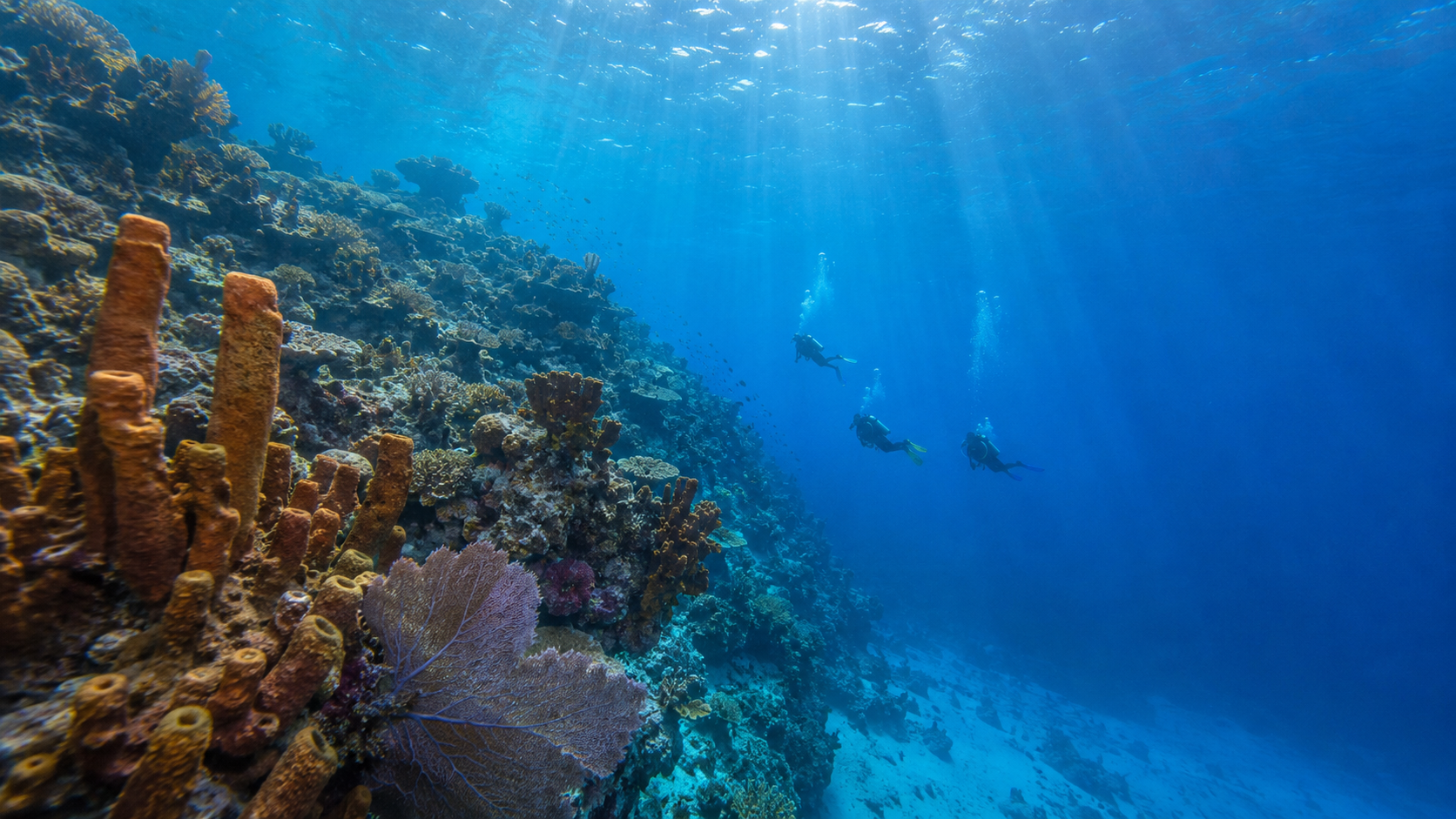
In daylight and clear water, I can build a mental picture of the dive site. I can see the reef line. I can see the open water. I can see where the group is moving. I can see my buddy without having to search too hard. I can see the guide’s position and body language. I can see the space above, below, and around me.
That information makes me calmer.
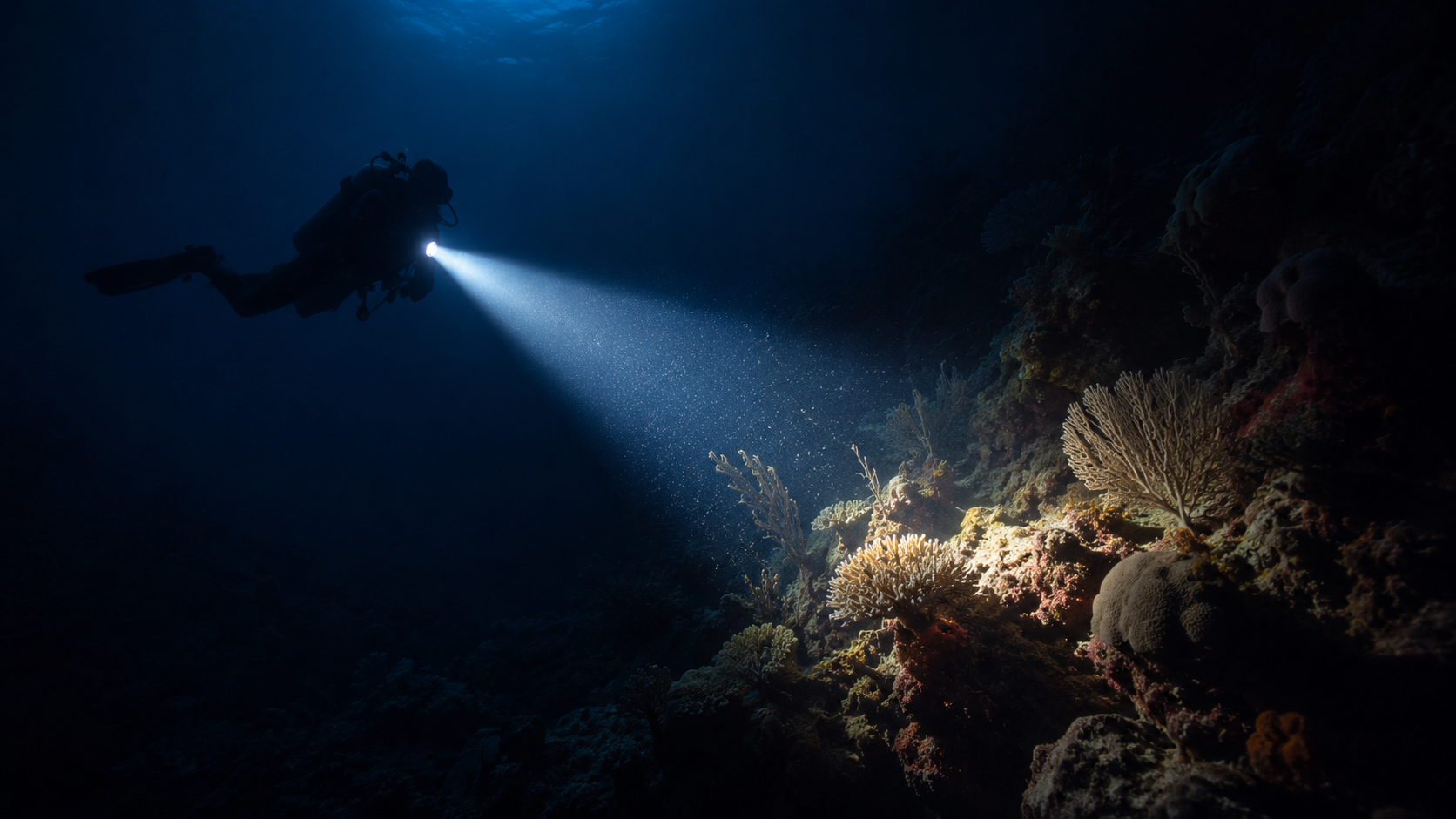
At night, the world gets smaller. The light only shows part of the scene. Everything outside that beam becomes less certain. Even if nothing is wrong, the dive feels different because my brain has less to work with.
That is the part I want to train through.
Not by pretending it does not bother me.
By learning how to function when the water gives me less information than I want.
Visibility Changes the Mental Workload
Visibility affects more than what you can see.
It changes how much work your brain has to do.
In good visibility, awareness feels easier. I can check my buddy with a quick glance. I can keep track of the reef and the group at the same time. I can see where the dive is going. I can anticipate changes before I am right on top of them.
When visibility drops, all of that gets tighter.
Peripheral awareness shrinks. The light beam becomes the main source of information. Buddy position matters more because separation can happen faster. Signals have to be cleaner. Movement has to be more deliberate. The dive plan has to be understood before anyone descends, because figuring it out later is harder when the visual field is reduced.
That is the mental load I am talking about.
It is not panic.
It is not fear of darkness by itself.
It is the knowledge that the dive requires more discipline because the water is giving you less.
That is why this course feels important to me. I do not want to be the diver who only feels confident when the visibility is perfect and the conditions are easy.
Perfect conditions are not a skill plan.
They are a best-case scenario.
The Light Becomes the World
A dive light changes the way you experience a site.
During the day, you can take in a whole scene. At night, the light decides what exists in that moment. The reef, the sand, a fish, a coral head, your buddy’s hand signal, your gauge, your computer, your own bubbles. Whatever the light touches becomes the dive.
Everything else is waiting outside the edge of the beam.
That can be uncomfortable, but it can also sharpen attention.
You stop scanning everything at once. You slow down. You choose where to look. You pay attention to what the light reveals instead of assuming the whole scene is available.
That is a skill.
Light discipline matters. Where the beam goes, how you signal, how you avoid blinding your buddy, how you check instruments, how you maintain awareness without waving the light everywhere like a search party. Those are habits I want to build correctly.
A dive light is not just a flashlight underwater.
It becomes part of communication.
It becomes part of navigation.
It becomes part of comfort.
It becomes part of control.
That is why I want training before treating night diving like something casual.
Why Night Diving Can Still Be Valuable
The fact that this course makes me uncomfortable does not mean I think it is a bad idea.
Actually, it is probably the opposite.
Some courses are valuable because they play to strengths. Others are valuable because they address a weakness or discomfort that should not be ignored. Night & Limited Visibility feels like the second kind.
Night diving can show a reef differently. Marine life behaves differently after dark. The colors under a light can be more focused. The whole dive can become slower, quieter, and more deliberate.
I can see the appeal.
I just do not want to skip past the part where it is also a different environment.
There is value in learning how to dive when visibility is reduced because not every dive is going to be bright, clear, and easy. If I can build comfort in limited visibility, that comfort carries into other situations: lower visibility freshwater, silty areas, darker reef sections, late-day dives, swim-through shadows, or any moment where the visual picture gets smaller than expected.
That is useful.
Not because I want to chase uncomfortable dives.
Because I want to be steadier when conditions are less comfortable.
Buddy Awareness Has to Become More Deliberate
In limited visibility, buddy awareness cannot be lazy.
During a clear daytime dive, it is easier to let distance stretch a little because you can still see each other. You may not even notice how much you are relying on visibility until it is gone.
At night, that changes.
Your buddy’s light becomes part of how you track them. Positioning matters more. Signals matter more. Staying close enough to communicate matters more. If someone turns away, drops slightly, or gets blocked by reef structure, the separation can feel bigger faster.
That is one of the reasons this course matters for me.
I want to become more deliberate about buddy awareness, not just assume I am good because I can usually see where everyone is.
Limited visibility forces better habits.
Where is my buddy?
Where is their light?
Are we close enough to signal?
Do they look comfortable?
Are we still following the plan?
Do we both know when to turn the dive?
That kind of awareness should exist on every dive, but limited visibility makes the cost of ignoring it more obvious.
Communication Has to Get Cleaner
Hand signals are different when the light is doing the work.
During the day, a signal is easier to see. At night, you may need to illuminate your hand, use the light itself, or signal in a way that makes sense without creating confusion. That requires discipline.
Sloppy communication is annoying in good visibility.
In limited visibility, it can become a real problem.
I want to get better at that. I want to understand how to signal clearly with a light, how to avoid blinding another diver, how to confirm a signal was received, and how to stay calm if communication takes an extra moment.
That last part matters.
When the environment feels smaller, it is easy to rush. But rushing is usually the wrong answer underwater. Clear communication takes a little patience, and patience is easier when the team has practiced.
That is one of the things I want from the course.
Not just “how to night dive.”
How to communicate when visibility is not doing me any favors.
What I Want From the Course
I do not need this course to make me fearless.
Fearless is not the goal.
I want confidence, not bravado.
There is a difference. Bravado says, “This does not bother me.” Confidence says, “I understand why this bothers me, and I have trained enough to handle it better.”
That is what I want.
I want to be more comfortable when the visual field shrinks. I want to trust my light use. I want better buddy communication. I want better discipline with positioning and awareness. I want to know what the dive plan should include before descending. I want to understand how to stay calm when I cannot see as much as I would like.
I also want to learn where my limits are.
That is part of training too.
Maybe night diving becomes something I really enjoy. Maybe it stays something I respect more than I seek out. Either way, I would rather know from training than from guessing.
How This Fits the Guide Path
Night & Limited Visibility also fits the bigger path I am looking at.
SSI’s professional lead path includes Dive Guide and Divemaster. If I am serious about moving in that direction, then I cannot only be comfortable in the conditions I already like.
A guide-level diver needs to be calmer in more situations.
That does not mean reckless. It does not mean pretending every dive is appropriate. It does not mean pushing conditions just to prove something.
It means being able to think clearly when the environment is less ideal.
Limited visibility is not just a scary environment. It is a skill environment. It tests communication, positioning, light discipline, navigation awareness, buddy contact, and emotional control.
Those are all guide-path skills.
Even if I never become someone who seeks out night dives for fun, I still want the discipline that comes from learning how to manage that environment.
That is the bigger reason this course belongs on the list.
What I Do Not Want to Do
I do not want to turn this course into a macho thing.
That is not useful.
I do not want to pretend I am not uncomfortable just because I think I should sound confident. I do not want to treat reduced visibility casually. I do not want to assume a good light solves everything. I do not want to rely on the guide so completely that I stop thinking for myself.
And I definitely do not want to confuse “I survived the dive” with “I handled the dive well.”
Those are not the same thing.
Handling the dive well means staying aware, communicating clearly, protecting the reef, maintaining buoyancy, tracking my buddy, managing the light, and following the plan.
That is the standard I want to build toward.
Why This One Matters Personally
Some courses are about expanding options.
This one feels like it is about expanding comfort.
That matters because comfort underwater is not just a feeling. It affects breathing, awareness, gas use, decision-making, and how much attention you can give to the team.
If limited visibility makes me tense, then I need to understand that. I need to train it. I need to learn what helps and what does not.
Ignoring discomfort does not make a diver stronger.
Working through it properly might.
That is how I am trying to look at this course.
Not as something to fear.
Not as something to shrug off.
As something that deserves honest attention.
Final Thought
Night & Limited Visibility has my attention because it takes away something I rely on: information.
It is not the dark itself that bothers me.
It is what the dark does to the dive.
It narrows the world. It makes the light more important. It makes buddy awareness more deliberate. It makes communication cleaner or more confusing, depending on how well the team handles it. It turns visibility into a skill issue instead of a comfort assumption.
That is exactly why I need the course.
I do not need to come out of it pretending the dark is nothing.
I need to come out of it better prepared when I cannot see everything I want to see.
Calmer.
More deliberate.
More useful to my buddy.
More disciplined with the light.
More comfortable when the water gives me less information.
That is the kind of confidence I want.
Not bravado.
Training.